How to Make Sauerkraut: A Beginner Fermentation Guide
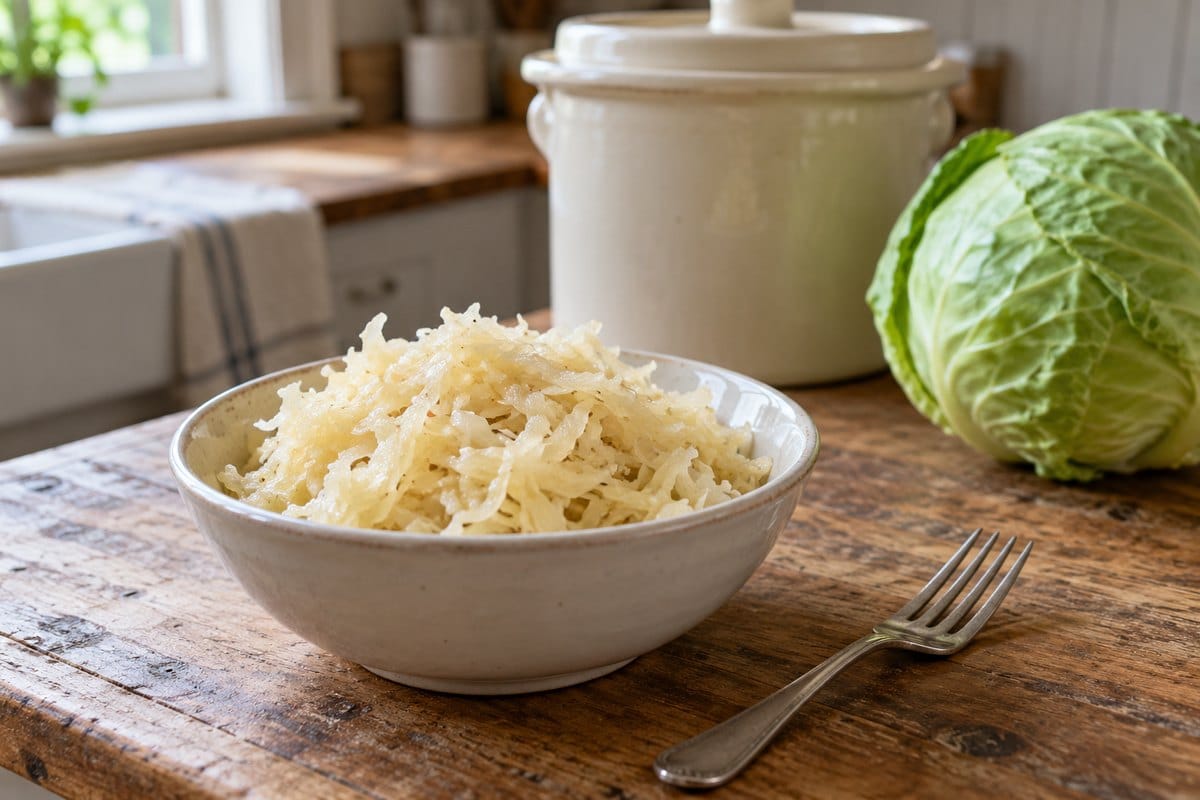
The cabbage squeaks against the knife, and the first handful of shreds barely fills the bowl. A few minutes later, the counter seems to be all cabbage. Making sauerkraut starts with that ordinary vegetable, but the useful decisions happen before it goes into the crock.
This guide explains how to make sauerkraut using the traditional crock-style method described by the National Center for Home Food Preservation (NCHFP). You will weigh the prepared cabbage, measure canning or pickling salt, keep the cabbage below its brine and give fermentation the right conditions. This is a fermentation-and-refrigeration guide, not a shortcut to shelf-stable jars.
Quick Answer
- For this crock-style method, use 3 level tablespoons of canning or pickling salt per 5 lb of prepared, shredded cabbage.
- Keep cabbage 1 to 2 inches below brine, with suitable weights and a clean cover.
- Aim for 70 to 75 F during fermentation. At that temperature, the usual time is 3 to 4 weeks.
- If you find mold, slime or a bad odor, discard the batch without tasting it.
- Refrigerate fully fermented sauerkraut. A lid alone does not make it shelf-stable.
The salt ratio follows Penn State’s crock-style directions; the NCHFP method gives the temperature and time. Keep one complete method together rather than borrowing a different salt amount from a small-jar recipe.
Table of Contents
Ingredients and Equipment for a First Batch
Plan the container before buying the cabbage. Shredded leaves take space, and the plate, weights and brine need room too.
| Item | What You Need |
|---|---|
| Cabbage | Enough fresh, firm heads to provide 5 lb after trimming, coring and shredding |
| Salt | 3 level tablespoons canning or pickling salt for that 5 lb of prepared cabbage |
| Container | A food-safe fermentation crock, food-grade plastic container or suitable glass container |
| Tools | A scale, measuring spoons, knife or suitable shredder, clean bowl, plate, weights and clean towel |
| Monitoring | A room thermometer, start-date note and a way to check acidity using reliable food-fermentation guidance |
NCHFP allows about 1 gallon of container capacity per 5 lb of vegetables. Choose enough room for the complete setup, not merely enough to squeeze in the cabbage. Use an intact food-use crock; do not use a decorative vessel of unknown glaze or a household storage bucket of unknown suitability.
For a quart-jar batch, follow a complete published small-batch method instead. Jar instructions can differ. Penn State notes greater spoilage concerns in small jars, where keeping every shred submerged can be harder.
Keep the Salt Ratio, Not Just the Salty Taste
Salt is part of fermentation control, not a seasoning you adjust before the process starts. NCHFP cautions against reducing salt in fermented sauerkraut. Do not make the starting mixture less salty because you prefer a milder finished dish.
Use level measuring spoons and the specified salt. NCHFP recommends canning or pickling salt and warns that flake salt has variable density. A tablespoon of coarse flakes is not a reliable substitute for the same volume of fine pickling salt. Reduced-sodium salt is not a suitable swap for this fermentation method.
Do not convert the spoon measurement into an invented gram value. If you want a salt-by-weight method, choose a complete research-based recipe that specifies it. For this first batch, keep the method and measurement basis together.
Prepare, Weigh and Salt the Cabbage
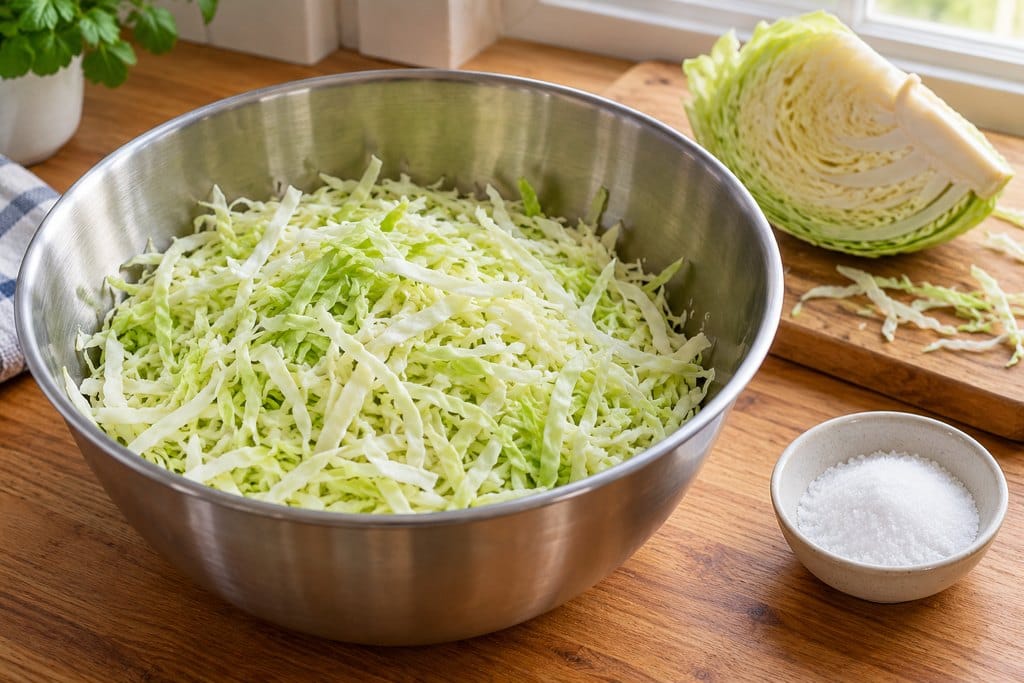
Start with a clean work surface, utensils, container and weights. Wash your hands before handling the cabbage. Clean equipment is still necessary even though fermentation deliberately encourages certain bacteria.
Penn State recommends discarding the outer cabbage leaves, rinsing the head, removing the core and slicing evenly to about the thickness of a quarter. Do not save discarded outer leaves as a cover; use the plate-and-weight setup instead. Use a knife or shredder you can handle safely.
- Weigh the prepared shreds. The weight of a whole head includes material you will discard.
- Measure the salt. For 5 lb of prepared cabbage, use 3 level tablespoons of canning or pickling salt.
- Mix thoroughly. With clean hands, work the salt through all the cabbage, not only the top handful.
- Pack firmly with its liquid. Transfer the cabbage and the juice it releases to the fermentation container. Press out air pockets.
Oregon State’s sauerkraut instructions describe mixing until salt dissolves and juices are drawn out. Keep the cabbage liquid; it belongs in the crock. There is no fixed number of minutes that every cabbage needs.
Keep the Cabbage Under Brine
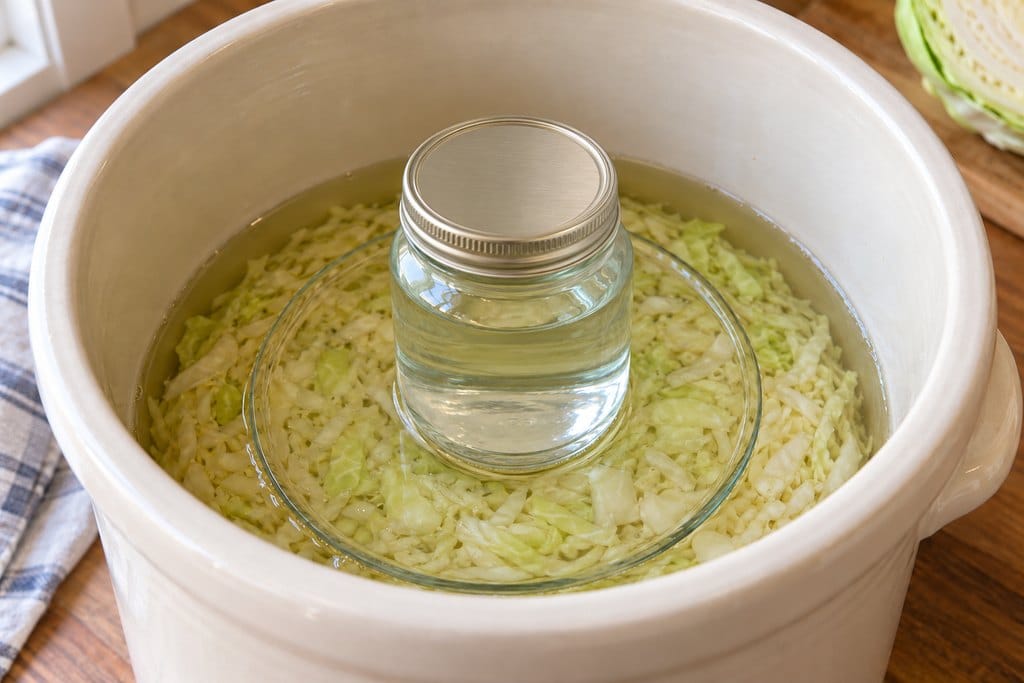
The cabbage surface is not the top of the liquid. Every shred should stay submerged, with 1 to 2 inches of brine above it. Leave the container rim at least 4 to 5 inches above the packed cabbage, as the NCHFP method directs.
Use a clean dinner plate or glass pie plate that fits inside the container and covers most of the cabbage. Weight it securely with closed, water-filled jars. NCHFP describes two to three quart jars; choose a container and arrangement that accommodate the plate and weights safely. The illustration shows one closed jar to make the arrangement visible, not a prescribed number of weights.
Wash the vessel, plate and weight jars in hot soapy water and rinse well before use. Cover the crock opening with a clean, heavy towel. This traditional covered-crock arrangement is not an instruction to seal fermenting cabbage inside an ordinary airtight jar.
If the Cabbage Does Not Release Enough Liquid
Use the recipe’s supplemental brine, not plain water: 1½ tablespoons canning or pickling salt per 1 quart of water, boiled and cooled. Add enough to cover the cabbage properly. NCHFP specifies this extra brine when cabbage juice is insufficient. It is a separate mixture, not a replacement for the salt already mixed into the cabbage.
Choose the Fermentation Spot Before You Need It
A counter beside the oven may be convenient without being a suitable place to ferment. Check the actual air temperature with a thermometer and look for a spot that stays reasonably steady.
| Temperature | NCHFP’s Expected Result |
|---|---|
| 70 to 75 F | About 3 to 4 weeks for full fermentation |
| 60 to 65 F | May take 5 to 6 weeks |
| Below 60 F | Fermentation may not proceed |
| Above 75 F | Sauerkraut may soften; avoid this as the planned fermentation condition |
Write down the start date, cabbage weight, salt amount and temperature. That short record is more useful for troubleshooting than remembering that the room felt comfortable.
Check Progress Without Treating Bubbles as a Safety Test
For the plate-and-jar-weight arrangement, check the crock two or three times a week. Confirm that the weights have not shifted and that cabbage remains below the brine. Oregon State describes this check schedule and removing surface scum if it forms.
A beginner should not have to identify an unfamiliar surface growth by guessing from a photo. If you cannot distinguish ordinary scum from mold, stop and ask your local Extension food-preservation specialist. Do not taste a questionable batch while deciding.
Minnesota Extension recommends monitoring acidity during vegetable fermentation and uses pH 4.60 or lower together with the end of bubbling as a readiness checkpoint. Use equipment suitable for food-fermentation pH testing and follow its calibration and sampling instructions. A measurement does not rescue a moldy or spoiled batch, and a few bubbles do not establish safe acidity.
If bubbling stops while pH remains above 4.60, Minnesota advises continuing fermentation and checking every one to two days. If acidification is not progressing or you are uncertain about your readings, get Extension guidance before eating or storing the batch. Do not pour in vinegar to disguise a failed fermentation.
Warning Signs, Refrigeration and Storage
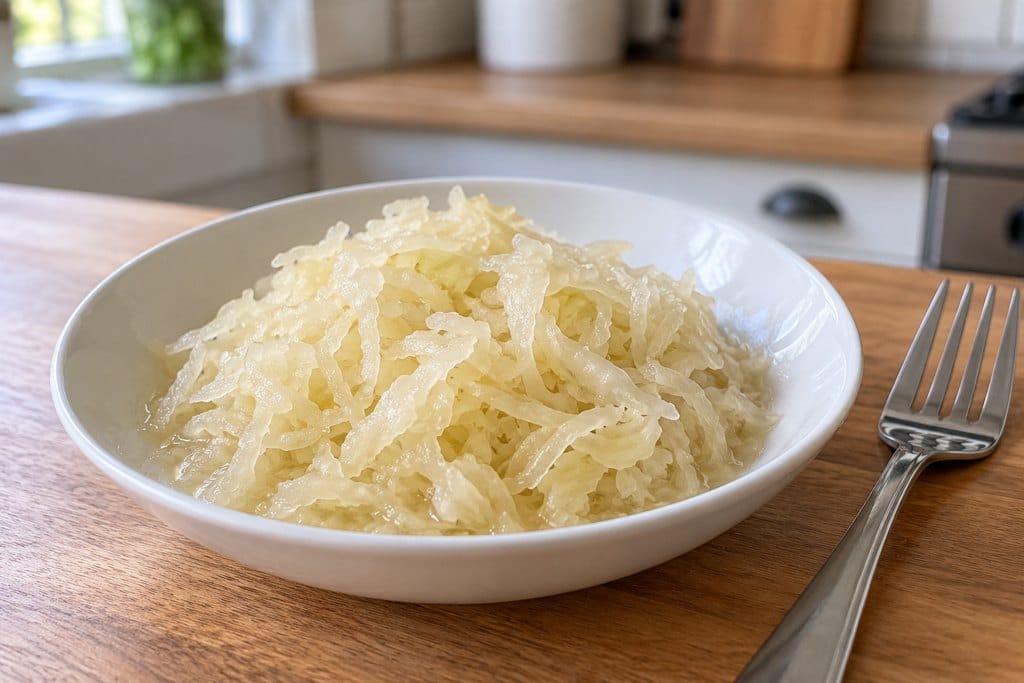
Penn State advises discarding sauerkraut with mold, a slimy texture or an unusual odor. Do not taste it first. For this beginner guide, that is the rule, rather than advice to scrape visible mold away and hope the rest is sound.
Appearance is useful for spotting a problem, not proving the absence of one. Penn State’s spoilage guidance explains that mold can extend into food and that harmful microorganisms are not reliably detected by sight, smell or taste.
Once fermentation is complete and the batch has no spoilage signs, transfer it with its brine to clean food-safe containers, cover and refrigerate. Penn State lists refrigeration for several months as a storage option. Label the date and continue checking stored food; this is not a guarantee that every batch keeps for the same period.
For shelf storage, use the full current tested canning process, including pack style, jar size and altitude adjustments. This guide does not provide canning times. Our overview of home food-preservation methods helps separate fermentation, refrigeration, freezing and canning so they do not become interchangeable shortcuts.
Common Sauerkraut Questions
Do You Add Vinegar to Sauerkraut?
Not in this method. The intended fermentation produces acid. A quick vinegar pickle is a different process, which our beginner pickling guide helps explain.
Can You Use Less Salt?
Do not reduce the salt in this fermentation recipe. If you need a low-sodium option, choose guidance developed for that purpose instead of changing this batch’s starting proportions.
Do You Need a Starter Culture?
The cited plain-cabbage method does not call for a purchased starter, whey or liquid from an older batch. Follow the specified cabbage-and-salt process. Our fermented dill pickle guide covers another vegetable fermentation, but its ingredient proportions are not substitutes for sauerkraut directions.
Can You Make It in Small Jars?
Yes, with a complete research-based jar method, appropriate weights and a way for fermentation gas to escape. Do not simply compress this crock setup into a quart jar and tightly seal an ordinary lid.