Best Food Mills for Canning Applesauce and Tomato Sauce: 5 Picks (2026)
In Homestead is reader-supported. When you buy through links on this page, we may earn a small commission at no extra cost to you. See our affiliate disclosure. As an Amazon Associate I earn from qualifying purchases.
A pot of soft, steaming apples smells like the whole orchard at once. Then comes the part nobody mentions in the recipe: the skins, the seeds and the bits of core all have to come out, and pushing hot fruit through a kitchen sieve with the back of a spoon turns a pleasant job into a sore-wrist hour.
A food mill solves that one problem very well. You crank cooked fruit or tomatoes through a perforated disc, and the smooth sauce drops into the bowl while the skins and seeds stay behind. For tomato sauce, it means you do not need to peel or seed tomatoes by hand.
This guide compares five food mills and crank strainers for home canners, from a simple bowl-top mill for a few jars of applesauce to a clamp-on strainer built for a bushel. It explains which type fits which harvest, and where a blender is the better tool after all.
Table of Contents
Quick Picks
- Best overall: Hungry Artisan 3-Disc Food Mill. Three interchangeable discs and a size that suits most canning batches.
- Best name-brand mill: OXO Good Grips Food Mill. A stable, well-supported mill that earns its cupboard space outside canning season too.
- Best for big batches: the Johnny Apple Sauce Maker. A crank strainer with separate sauce and waste outlets, built for long runs.
- Classic crank strainer: the Norpro Sauce Master. The traditional clamp-on design with interchangeable screens.
- Best simple budget mill: the Mirro Foley Food Mill. One disc, no fuss, fine for small batches of applesauce.
Food Mill, Food Strainer or Blender?
These three tools get lumped together, and they do different jobs.
A rotary food mill sits on top of a bowl or pot. You fill the hopper with cooked food and turn a handle that sweeps a blade across a perforated disc. It handles a few quarts at a time, then you scrape out the skins and seeds and refill it.
A crank food strainer, sometimes sold as a sauce maker or tomato strainer, clamps to the counter. Food goes into a hopper, an auger pushes it against a cone-shaped screen, sauce runs out one chute and skins and seeds exit another. It keeps working as long as you keep feeding it, which is why people who put up tomatoes by the bushel swear by them.
A blender or food processor purees everything you put in, skins and seeds included. That is fine for some sauces, but many cooks find pulverized tomato seeds give a sauce a bitter edge, and blended apple skins change the texture and color of applesauce. If you want the classic smooth result, you need something that separates rather than chops.
The National Center for Home Food Preservation describes exactly this choice in its tested applesauce method: after peeling, coring and cooking the apples, press them through a sieve or food mill for a smooth sauce, or skip that step for a chunky one. For tomato sauce, its standard method presses cooked tomatoes through a sieve or food mill to remove skins and seeds. A mill prepares the fruit; the tested recipe’s preparation, acidification and processing steps are what make the jars safe.
What to Look for in a Food Mill
Rotary Mill or Crank Strainer
Decide this first, because it matters more than any brand. A rotary mill is cheaper, smaller and easier to store, and it is the right tool if you make a dozen jars of applesauce a year. A crank strainer costs more and needs a sturdy counter edge to clamp to, but it is far faster for large harvests because skins and seeds leave through their own outlet.
Disc and Screen Sizes
Fine discs make silky sauces and catch tomato seeds and raspberry seeds. Medium discs suit applesauce and most tomato sauce. Coarse discs leave texture for things like chunky sauce or mashed potatoes. A mill with only one disc limits you; three discs give useful texture choices for applesauce and tomato sauce.
Batch Size
Be honest about volume. A 2-quart hopper means many refills when you are processing 20 pounds of tomatoes, and every refill means scraping out skins. If your canning day starts with a bushel basket, skip ahead to the crank strainers.
Stability on the Bowl or Counter
A mill that wobbles while you crank is tiring and messy. Look for folding legs or hooks that grip the rim of your bowl, and check which bowl diameters they fit. Crank strainers need a counter or table edge thick enough for the clamp, and a smooth, sturdy surface.
Cleaning
Stainless steel parts clean easily and do not stain from tomatoes. Rinse the mill before the pulp dries, because dried apple and tomato fiber packs into the holes of the disc and takes real scrubbing to remove. Plastic hoppers on crank strainers can take on a tomato tint over time, which is cosmetic.
The 5 Best Food Mills for Canning
Best Overall
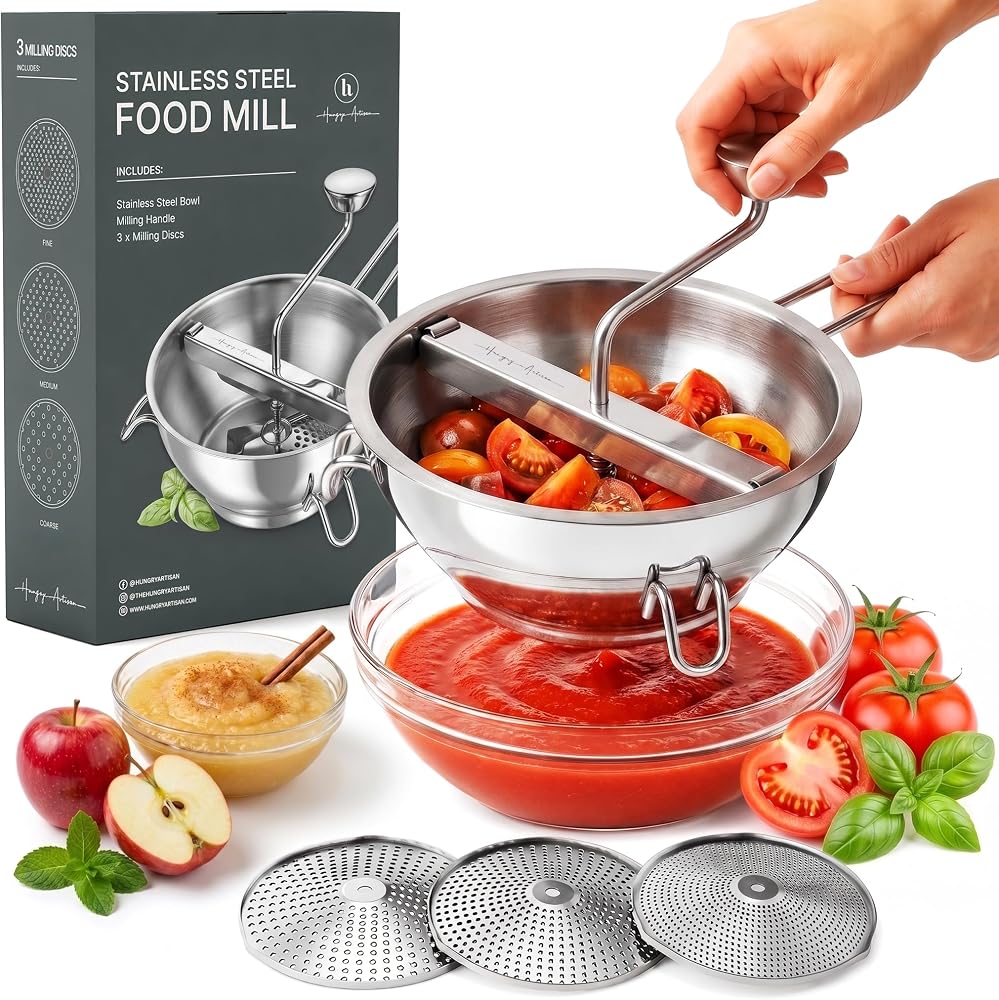
Hungry Artisan 3-Disc Stainless Steel Food Mill
This is the mill that covers the widest range of canning jobs without getting complicated. It has a 3.5 qt stainless steel bowl and three interchangeable discs, listed by the maker at 1, 2 and 4 mm, so you can go from seedless tomato sauce to a rustic applesauce by swapping one part.
Hooks on the side rest it on pots or bowls at least 8 inches across, and the whole thing comes apart for cleaning and goes in the dishwasher. The maker states the parts that touch food are stainless rather than plastic, which matters when you are milling hot, acidic tomatoes.
- Best for: applesauce, tomato sauce and pumpkin puree in the batch sizes most home canners actually make.
- Keep in mind: it is still a batch tool. For a bushel of tomatoes you will be scraping out skins and refilling the hopper many times.
Best Name-Brand Mill
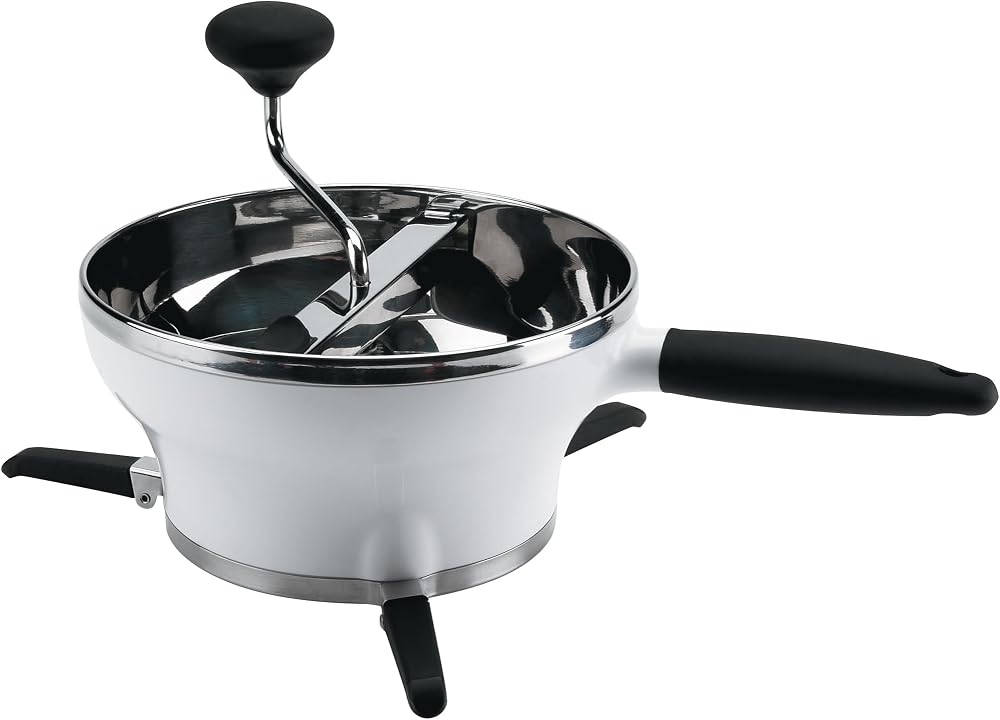
OXO Good Grips Stainless Steel Food Mill
OXO’s mill is the smaller, tidier option, and one of the easiest to use. It has a 2.3 qt stainless bowl, fine, medium and coarse discs that swap with a release button, and folding legs that grip the bowl and fold flat for storage.
OXO’s own instructions cover the two jobs home canners care about most: removing tomato skins and seeds, and milling unpeeled cooked apples. It is dishwasher safe, and because it is pleasant to use it tends to come out of the cupboard for mashed potatoes and soups too.
- Best for: cooks who want a mill that doubles for mashed potatoes and soups the rest of the year.
- Keep in mind: the bowl is smaller than the 3.5 qt mills, so plan on more refills, and OXO advises reversing the crank often to keep food moving.
Best for Big Batches
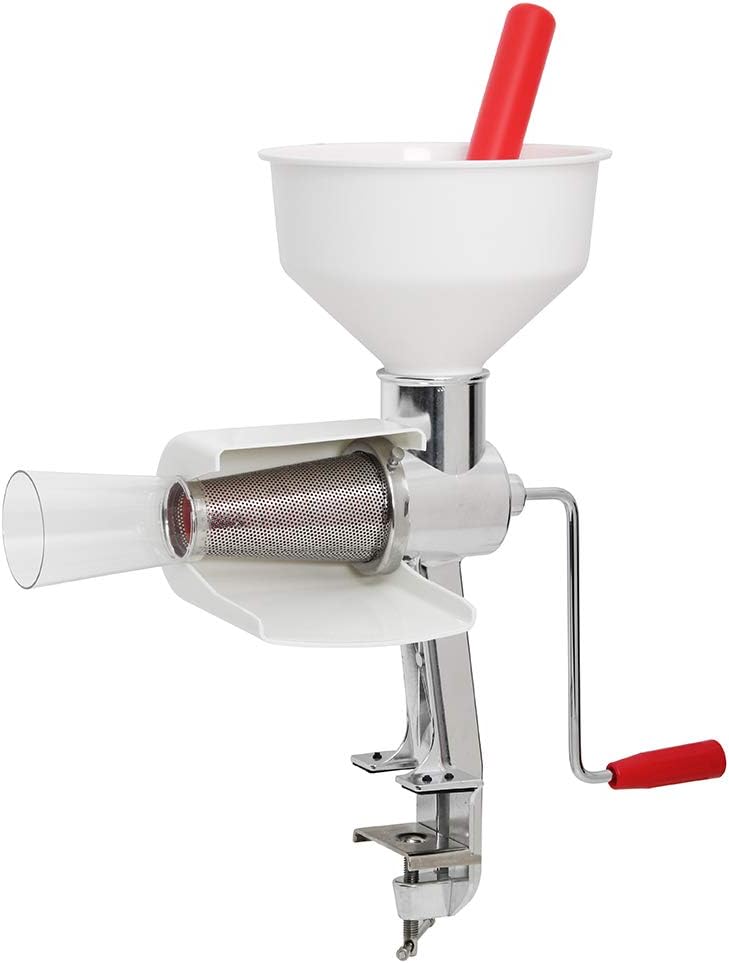
Johnny Apple Sauce Maker (Food Strainer)
The Johnny is a crank strainer rather than a bowl mill, and that is the point. It clamps to the counter, an auger pushes food against a stainless screen with 1.3 mm holes, sauce runs out one chute and skins and seeds come out a separate waste spout. You keep feeding it and it keeps going.
That continuous design is what makes it worth considering when apples or tomatoes arrive by the box. Replacement screens and an optional motor are sold separately, and the maker’s current manual lists a five-year limited warranty.
- Best for: a bushel of apples or a garden full of tomatoes, when a hand-turned bowl mill would take all afternoon.
- Keep in mind: the manual says not to feed it hot food because the plastic parts can be damaged, so let cooked fruit cool first. It needs a solid counter edge for the clamp and is hand wash only.
Classic Crank Strainer
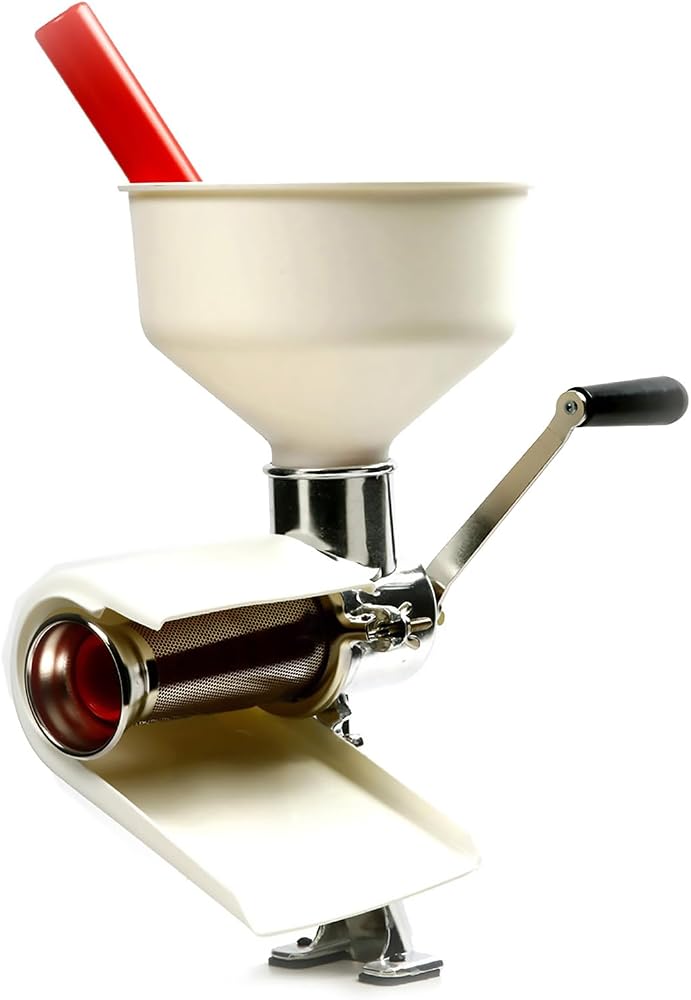
Norpro Sauce Master Food Strainer
The Norpro Sauce Master is the classic version of the same idea: a 3 qt hopper, a hand crank, a counter clamp, and a fine screen that separates skins and seeds from the sauce. It has been a fixture of home canning kitchens for decades.
One fine screen comes in the box. Berry, pumpkin and salsa screens are sold separately if you want to strain other produce. Parts are replaceable, which keeps an old strainer going for many seasons.
- Best for: canners who want the traditional clamp-on strainer design and a choice of screens.
- Keep in mind: it is hand wash only, and accessory parts for this model (1951) do not fit the Sauce Master II (1991), so check the model number before ordering extra screens.
Best Simple Budget Mill
Mirro Foley Stainless Steel Food Mill
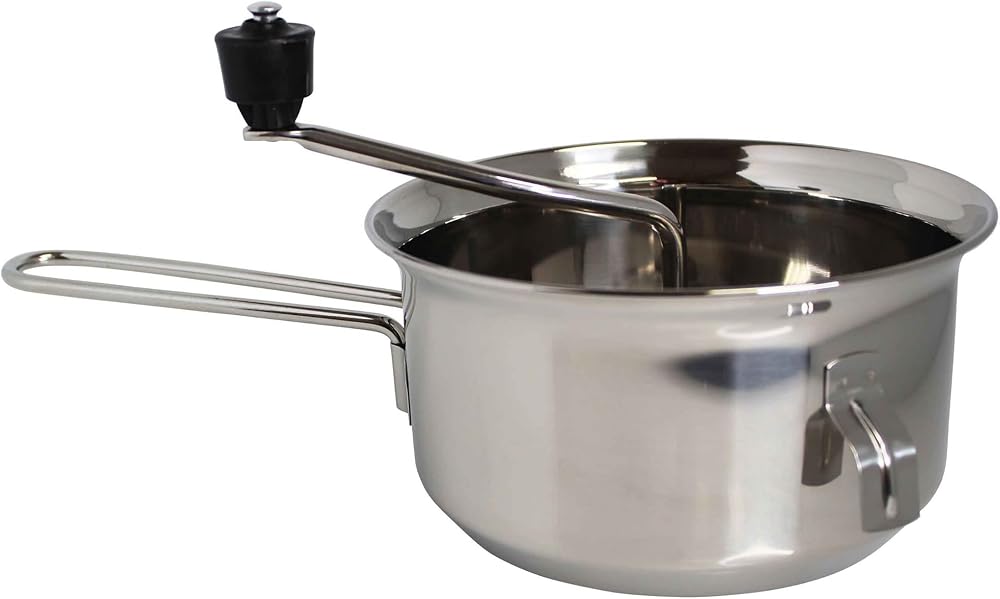
The Foley mill is about as simple as a food mill gets: a 3.5 qt stainless steel bowl, a hand crank, and one fixed fine disc. It rests on a bowl or pot by its hooks and turns cooked apples or tomatoes into sauce while holding back the skins and seeds.
With only one disc there is nothing to choose and nothing to lose. It goes in the dishwasher, and for a few jars of applesauce a year it does everything you need.
- Best for: small batches of applesauce and anyone who wants the plainest possible tool with nothing to lose.
- Keep in mind: there are no texture options and no legs or clamp, so you need a bowl it sits on securely. One retailer lists it as limited stock, so check availability.
Quick Comparison
| Model | Type | Best For | Discs or Screens | Main Trade-Off |
|---|---|---|---|---|
| Hungry Artisan 3-Disc | Rotary mill | Most canning batches | 3 discs (1, 2, 4 mm) | Batch refills on big harvests |
| OXO Good Grips | Rotary mill | Year-round kitchen use | 3 discs (fine, medium, coarse) | Smaller 2.3 qt bowl |
| Johnny Apple Sauce Maker | Crank strainer | Bushel-size harvests | 1 screen (1.3 mm); others sold separately | Cool food first; needs a clamp edge |
| Norpro Sauce Master | Crank strainer | Traditional strainer fans | 1 fine screen; others sold separately | Hand wash only |
| Mirro Foley | Rotary mill | Small batches on a budget | 1 fixed fine disc | No texture choices |
How to Use a Food Mill for Applesauce and Tomato Sauce
The milling step is the same for both, and it is simpler than it looks. What changes is the preparation your tested recipe calls for.
- Prepare and cook as the recipe says. For canned applesauce, the NCHFP method has you wash, peel, core and slice the apples, then cook them soft in a little water. For tomato sauce, the standard tomato sauce method has you cut and heat the tomatoes, then press them to remove skins and seeds. Unpeeled apples are fine for applesauce you will refrigerate or freeze.
- Set up over a wide bowl. Seat the mill firmly on the rim, or clamp the strainer to the counter with a bowl under each chute. If your strainer has plastic parts, let the cooked fruit cool to warm first; the Johnny manual, for one, says not to feed it hot food.
- Work in batches. Fill the hopper about two-thirds full and crank. Reverse the handle every few turns on a rotary mill to clear the disc.
- Scrape and refill. When mostly skins and seeds remain, scrape them out and start the next batch. On a crank strainer, run the skins back through once to catch the last of the pulp.
- Follow your tested recipe from here. Return the sauce to the pot, reheat or reduce it as the recipe says, and process the jars for the full time.
Tomato sauce needs one extra step that the mill does not change: added acid. Tomatoes sit close to the line between high- and low-acid foods, so tested recipes call for bottled lemon juice or citric acid in every jar. Texas A&M AgriLife Extension walks through the press-reduce-acidify sequence. Our step-by-step guides to canning applesauce and canning tomato sauce cover the full recipes, and a water-bath canner handles both.
A food mill also earns its keep beyond canning season. It makes smooth pumpkin puree without stringy bits, seedless berry jam, and lump-free mashed potatoes.
How We Chose
These mills were researched rather than tested side by side in our kitchen, and we would rather say that plainly. We compared disc and screen options, hopper capacity, materials, how each one attaches to a bowl or counter, and cleaning. We compared manufacturer specifications, manuals and published warranties, named independent tests where they exist, and the specific limitations we could verify, and we flag any figure that comes only from a seller listing.
We weighted the needs of home canners over general cooks: removing skins and seeds from apples and tomatoes, handling a real harvest, and holding up to a long canning day. We do not list prices, because they change constantly. Use the buttons to check current prices.
Got the mill? Here is what to put in the jars.
The Beginner’s Canning eBook covers water-bath canning end to end: altitude and headspace charts, the acidity rules that decide what is safe, and step-by-step walkthroughs for a first season. The Canning Starter Bundle adds both Quick Kits for jar prep and fermenting.
Frequently Asked Questions About Food Mills
Do you need a food mill to make applesauce?
No. The tested canning method makes the milling step optional: you can mash peeled, cored, cooked apples or skip pressing for a chunky sauce. A food mill gives the smoothest result with the least effort, which matters more as the batch gets bigger. For refrigerator or freezer applesauce, it also lets you skip peeling.
Is a food mill better than a food processor?
For sauces you want smooth and seed-free, yes. A food processor chops everything together, so skins and seeds end up in the sauce. A mill separates them out. For chunky salsa or pesto, the processor is the better tool.
Does a food mill remove tomato seeds?
Yes, with the fine disc or a standard tomato screen. Most seeds and nearly all the skin stay in the mill. A few seeds may slip through a medium disc, which most people do not notice in a cooked sauce.
Which disc should you use for tomato sauce?
Start with the fine disc if you want a smooth, seedless sauce. Use the medium disc if you prefer a little more body and do not mind the occasional seed. The coarse disc leaves too many seeds for most tomato sauce.
Can you put raw apples through a food mill?
Not well. Raw apples are too firm for a rotary mill and mostly jam the disc. Cook them until soft first. Cooked fruit mills faster, jams less and gives more sauce.
The Bottom Line
For most home canners, the Hungry Artisan 3-Disc Food Mill is the one to get: three discs, a sensible size, and stainless parts that clean up easily. If your harvest arrives by the bushel, a crank strainer like the Johnny Apple Sauce Maker will save you hours. Either way, start with a tested recipe, and our guide to canning applesauce is an easy first batch.