Chickens Molting: What Is Normal and How to Help
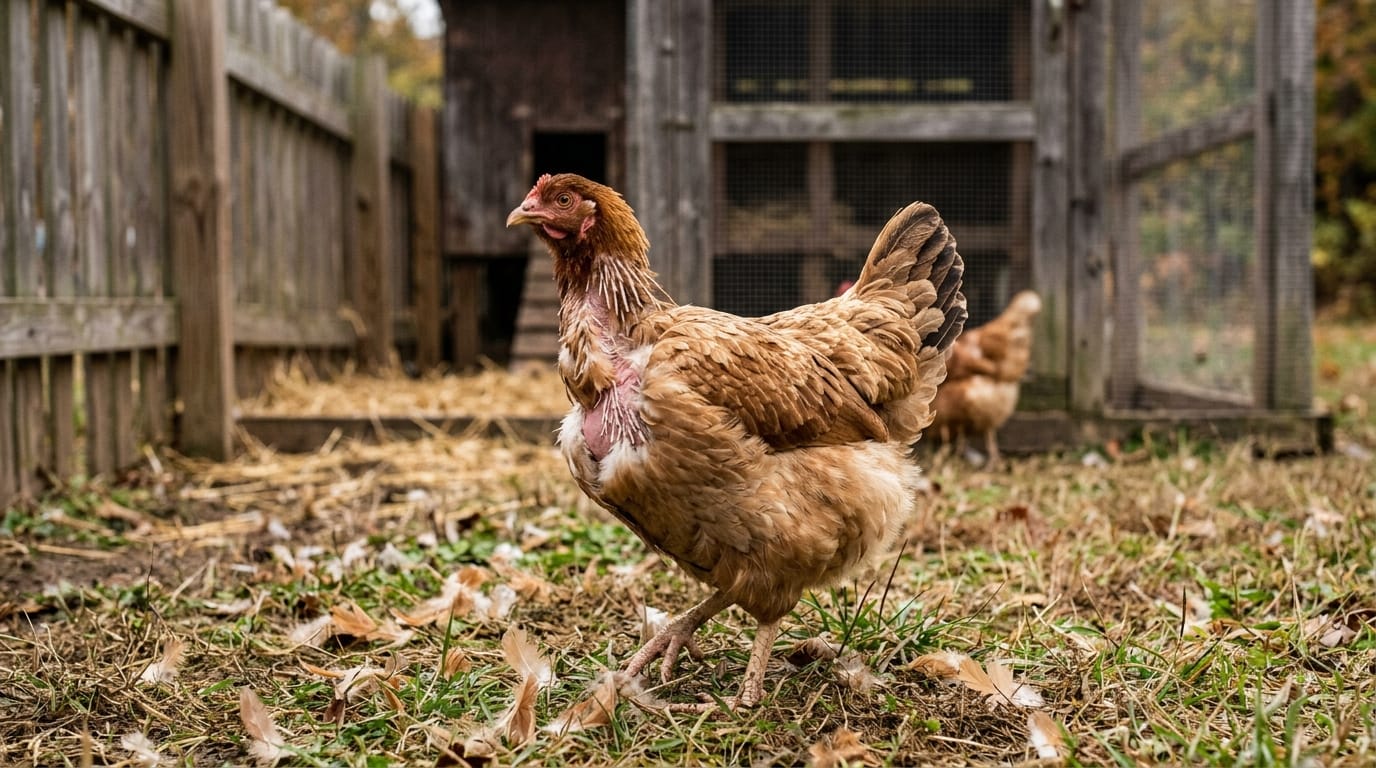
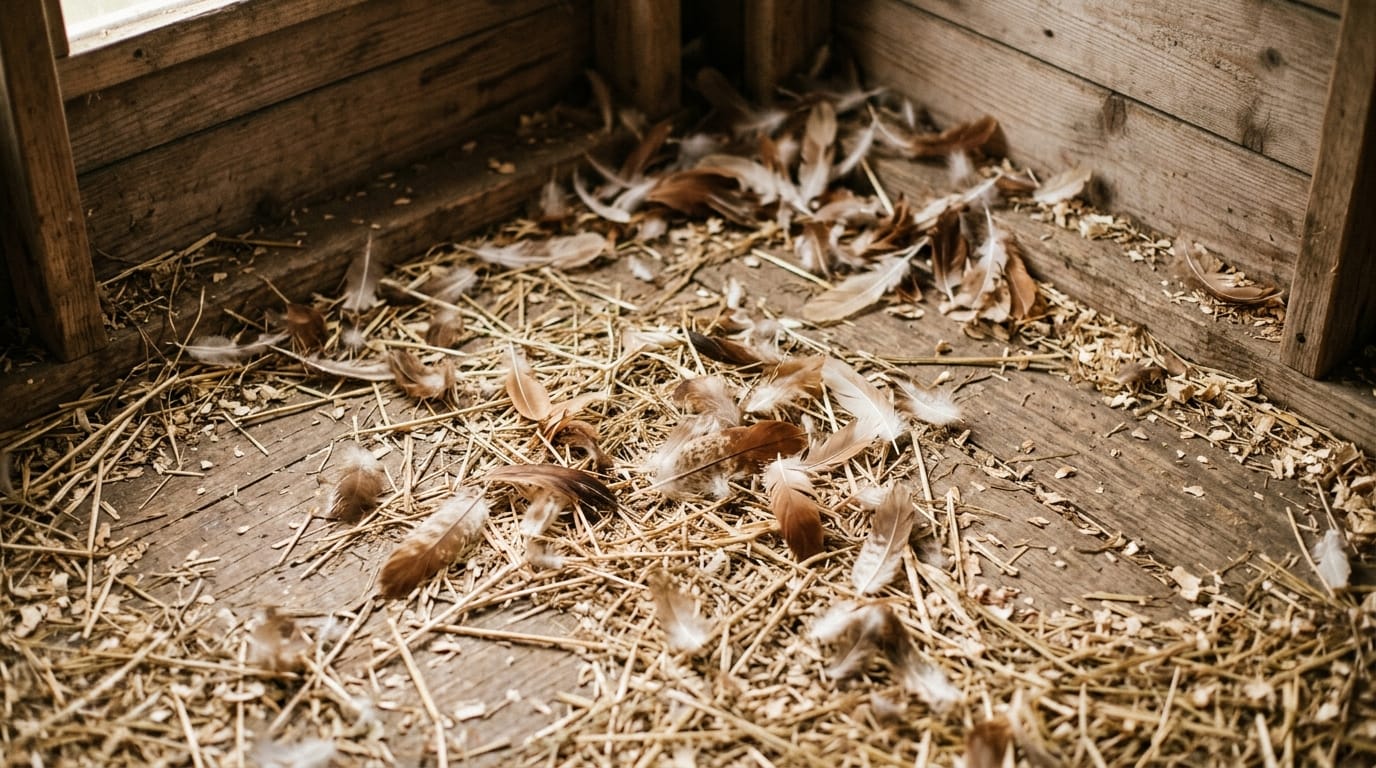
The first fall molt is alarming if nobody warns you. You walk out on a September morning and the run looks like something happened in the night: feathers drifted against the fence, a hen standing in the middle of it with a bare pink neck and a look of quiet indignation, and the nest boxes empty for the first time since spring.
Nothing happened. She is molting, which is the annual business of dropping a worn-out set of feathers and growing a new one. It is uncomfortable to watch and it stops the eggs for a while, but it is normal, it is seasonal, and for most flocks it needs no intervention at all. The useful skills are telling a real molt apart from the problems that look like one, and knowing which kind of help actually helps.
The short answer
Chickens Molting in Brief
- What it is: an annual feather replacement, triggered by the shortening days of late summer and fall.
- Who: adult birds. A spring-hatched pullet usually skips her first fall and molts the following year instead.
- How long: roughly two to three months in a fast molter, four to six in a slow one.
- Eggs: production slows or stops, then returns once the feathers finish.
- The one real tell: a molt brings new feathers in behind the loss. Bare skin with nothing coming through is a different problem.
- The help that works: a more concentrated feed and fewer treats, which is the opposite of what most people do.
Table of Contents
What Molting Actually Is
A feather is a dead structure. Once it has grown out it cannot be repaired, so a bird that lives outdoors in weather and dust and other chickens ends the season with a coat that is faded, frayed and no longer waterproof. The fix is wholesale replacement. As Mississippi State Extension puts it, each year chickens lose the older feathers and grow new ones, and most birds stop laying while they do it.
That pause is the part worth understanding. Feathers are built almost entirely from protein, and a hen who is growing a full new coat is running an expensive construction project on the same daily ration that used to produce an egg. She cannot do both well. Egg production is what gets cut.
Young birds also change feathers as they grow, which catches people out. A chick losing her down, or a half-grown bird swapping one set of juvenile feathers for another, is passing through a growth stage rather than the annual molt. The molt this article is about is the adult one, and it runs on the calendar rather than on the bird’s age.
When Chickens Molt, and How Old They Are the First Time
The trigger is day length. As the light drops off after midsummer the reproductive system winds down and the feather replacement begins, which is why University of Arizona Cooperative Extension describes the molt as arriving with the onset of fall, roughly across August to October. Local weather shifts it by a few weeks in either direction, and individual birds within one flock will start weeks apart.
Age is the part that surprises new keepers. Extension puts the good layers at twelve to fourteen months of production before their first molt, and pullets come into lay somewhere around eighteen to twenty-two weeks old. Put those two numbers together and the first real molt lands at roughly sixteen to nineteen months of age.
For a spring-hatched chick, that means she will not molt in her first fall. She will lay straight through her first winter, often better than the older birds, and then molt in the fall of her second year. If a six-month-old pullet is dropping feathers in October, a molt is the least likely explanation and it is worth working through the bare-patch checklist below instead.
This is also why a mixed-age flock rarely goes quiet all at once. Last year’s hens molt, this year’s pullets keep laying, and the egg basket dips instead of emptying. If you are still working out when your own birds should start, we cover the timing in when chickens start laying eggs.
The Hen Who Looks Worst Is Usually Your Best Layer
Here is the piece almost nobody tells beginners, and it reverses the obvious reading of what you are looking at. The hen who goes half bald in a week and looks genuinely rough is usually the better producer. The hen who looks mildly scruffy from August until January is usually the worse one.
Mississippi State Extension separates birds into late molters, which lay for twelve to fourteen months before they molt and then get the whole thing over with in two to three months, and early molters, which quit production after only a few months and then take four to six months to finish. Late molters are described as generally the better laying hens. Early molters are described as usually poor producers.
The mechanism is in how the feathers come out. Late molters drop their big wing feathers in groups of two or more at a time, so the loss is dramatic and the regrowth overlaps. Early molters drop them one at a time in strict order, which looks tidier day to day and drags the whole process out for months. A fast ugly molt is a short molt.
Worth keeping in proportion
This is a tendency, not a verdict
This comes out of flock-level culling guidance written for people deciding which hens to keep, and it describes a pattern rather than an individual fate. A slow molter can be a perfectly good bird who had a hard summer. It is useful for reading your flock, not for passing sentence on a hen you are fond of.
How Long a Molt Lasts
Two to three months for a fast molter, four to six for a slow one, counted from the first loose feathers to a finished coat. Most backyard birds land somewhere in the middle, and the visible drama is concentrated in the first few weeks.
| What you are seeing | Likely type | Rough time to finish |
|---|---|---|
| Big handfuls of feathers at once, bird looks shocking within days | Fast molter, the better layer | 2 to 3 months |
| A steady light shed, bird never looks truly bare | Slow molter, often a weaker layer | 4 to 6 months |
| Loss that started in late summer with no new feathers showing by four weeks | Probably not a molt | Work through the bare-patch table |
Counting Wing Feathers to See How Far Along She Is
There is a field method for this, out of the same its companion page on culling hens, and it is genuinely handy because it turns a guess into a number. Each wing carries ten large primary feathers, separated from the smaller secondaries by one short axial feather. Spread a wing gently and you can see them: old feathers are frayed and faded at the tip, new ones are clean, dark and stiff, and the boundary between them is usually obvious.
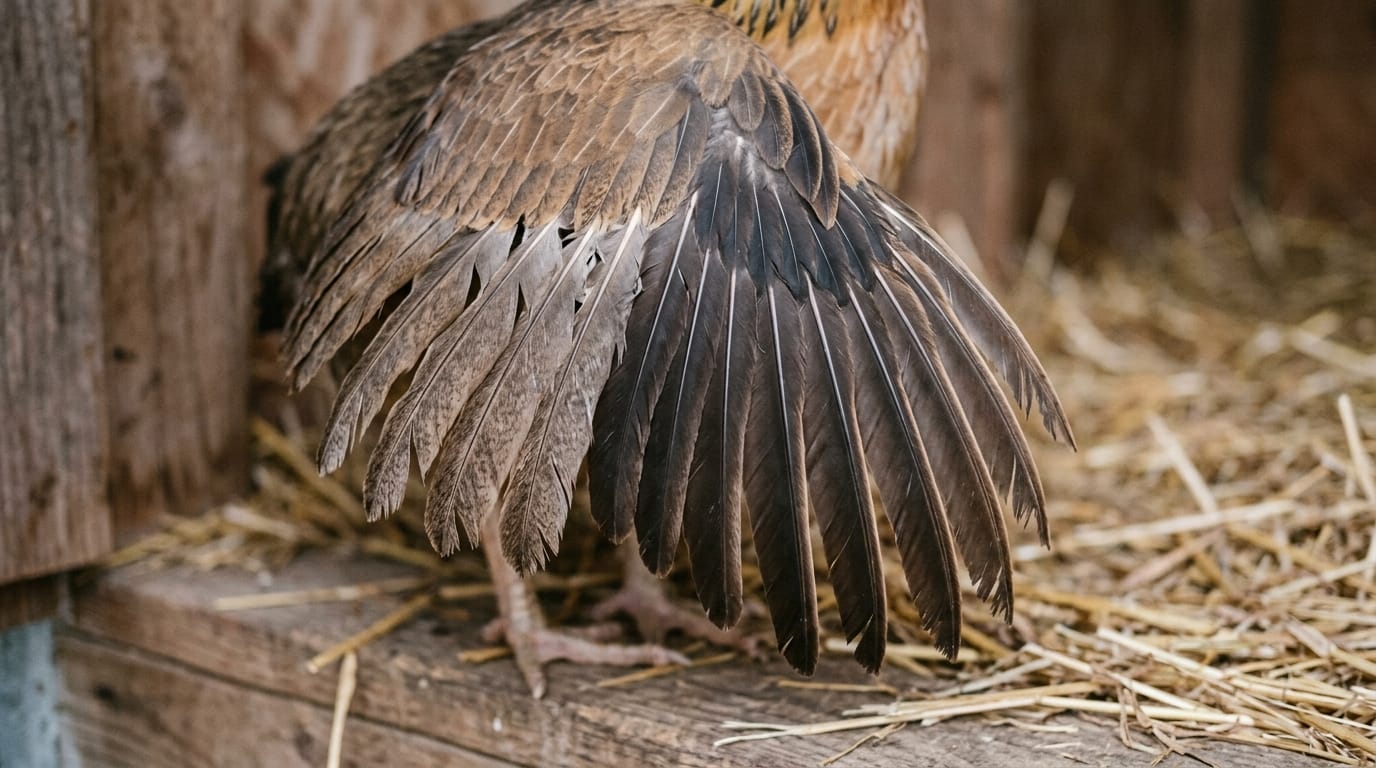
The rule is six weeks for the first primary or group of primaries she replaced, then two weeks for every feather or group after that. Count what has been renewed and you get a reasonable estimate of how long she has been at it.
| New primaries counted | Dropped one at a time | Dropped in groups |
|---|---|---|
| 1 feather or group | about 6 weeks in | about 6 weeks in |
| 2 | about 8 weeks | about 8 weeks, and close to done |
| 3 | about 10 weeks | about 10 weeks, finishing |
| 5 | about 14 weeks | not applicable |
| All 10 | about 24 weeks, near 6 months | not applicable |
Run that arithmetic out and it explains the two published ranges rather neatly. A bird dropping all ten primaries one at a time reaches about twenty-four weeks, which is the top of the four-to-six-month figure for slow molters. A bird dropping them in two or three groups reaches eight to ten weeks, which is the two-to-three-month figure for fast ones. The same rule produces both numbers, which is a good sign it reflects something real.
What a Molting Chicken Looks Like
The loss follows a route. Feathers go from the head first, then the neck, then the breast and body, then the wings, then the tail, and within the wing the long primaries go before the secondaries. That order is consistent enough to use as a check: a bird who is bare at the neck and fully feathered everywhere else is early in a normal molt.
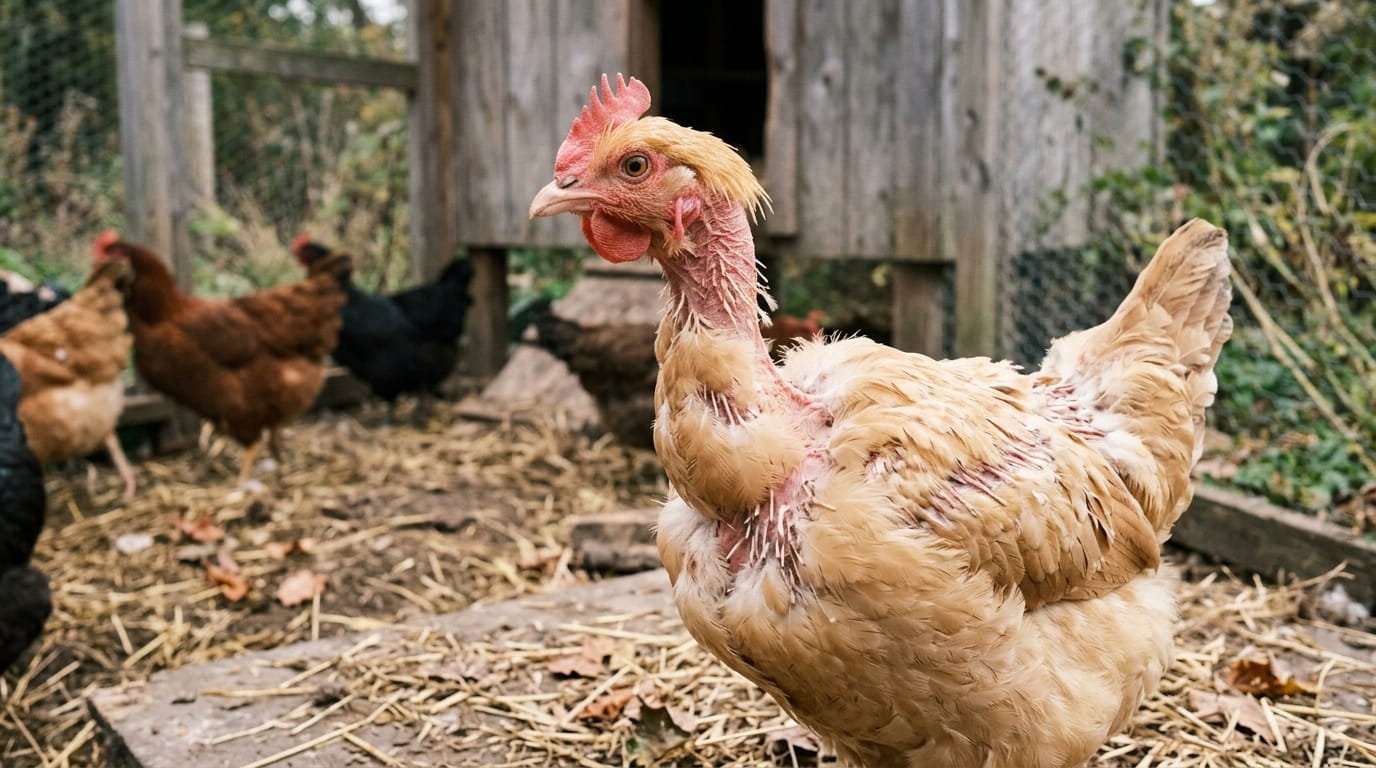
The bare neck is the image people arrive at this article carrying, and it is the most alarming stage of an entirely ordinary process. Some breeds take it further than others and a few birds get genuinely close to naked across the shoulders and back.
Behind the loss come the pin feathers. A new feather pushes up wrapped in a waxy sheath with a live blood supply inside it, so the bird looks briefly like she has been quilled. Over days the sheath dries, splits and flakes off, and the feather unfurls out of it. You will find the flakes on the roost and in the bedding.
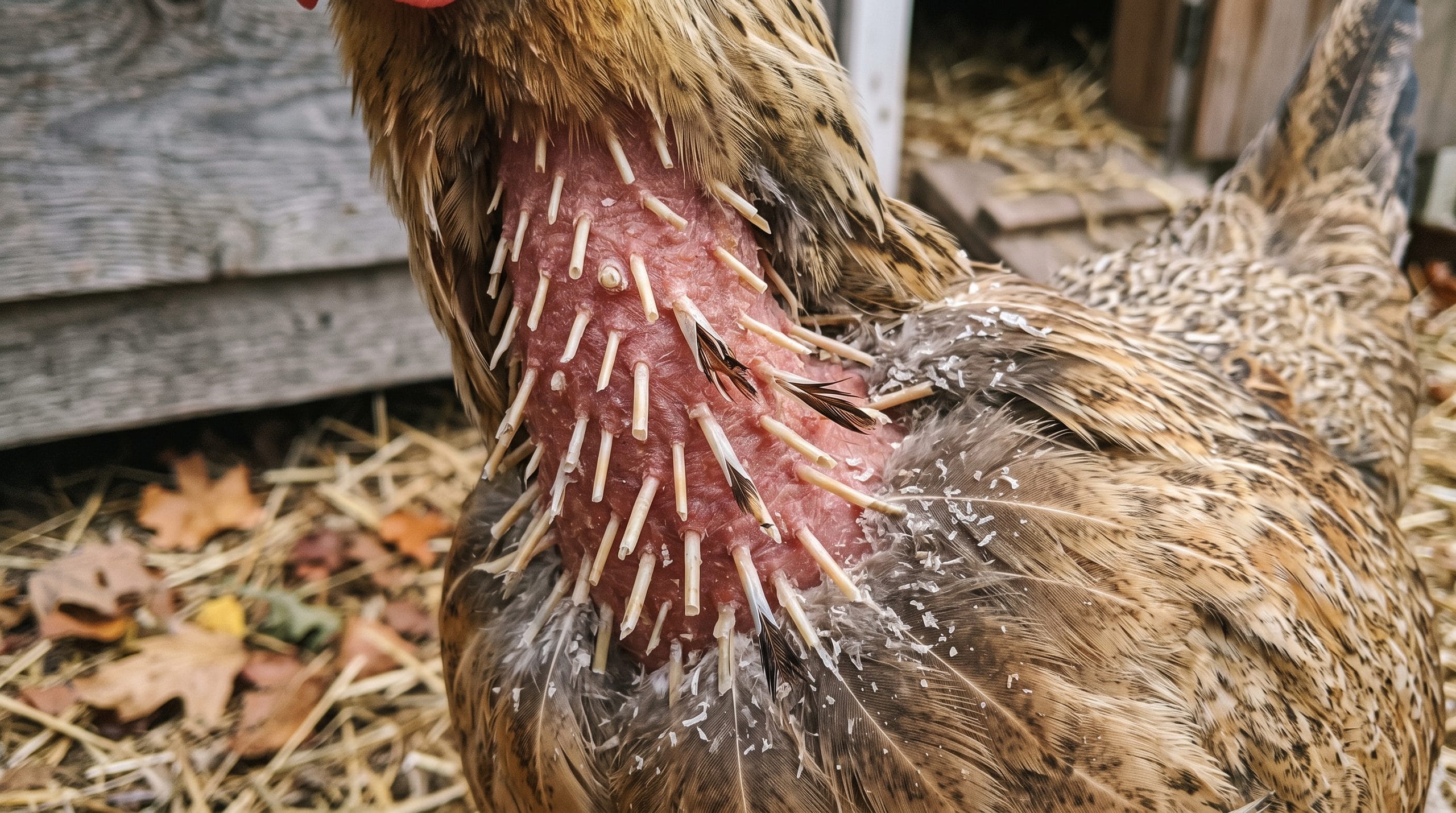
Other things that come with it and are not a cause for concern on their own: a comb that goes paler and shrinks back, a bird who is quieter and less interested in the flock, less appetite for the usual scramble at the feeder, and a hen who dislikes being touched. She is sore. All of that resolves with the new coat.
Molt, or Something Else? Read the Bare Patch
Most feather loss questions answer themselves once you notice where the feathers are missing, because a molt has a route and the other causes have locations. Here is the whole differential in one place.
| Where the feathers are gone | Most likely cause | What else you would see |
|---|---|---|
| Head and neck first, then working back down the body | Normal annual molt | Pin feathers pushing through within days, loose feathers everywhere, laying stops, bird over about sixteen months old, late summer or fall |
| Around the vent, with the remaining feathers darkened and matted | Northern fowl mites | Tiny dark specks at the base of the vent feathers, a pale comb, an egg drop with no regrowth, roosters often the worst affected |
| Feathers chewed or ragged at the base, birds unsettled on the roost at night | Roost mites or lice | Roost mites hide off the bird by day, so check the underside of the roost after dark |
| The back and the feathers behind the head, on hens only | Mating wear from a rooster | Clean worn patches with no pin feathers, only on his favorites, regrows when breeding slows |
| The breast alone, on a hen flat in the nest box | A broody hen plucking herself | She sits all day, growls when approached, and the bare skin is deliberate |
| Backs and tails looking picked over, sometimes raw | Feather pecking | No regrowth, often traced to crowding, boredom or a thin ration, and blood draws more pecking |
| Patchy loss any time of year with nothing growing back | A ration problem | Poor feather quality across the whole flock rather than one bird |
The test that settles it
Look for what is coming in, not what fell out
A molt always brings new feathers in behind the loss, so within a week or two of a patch going bare you should be able to see pin feathers pushing through the skin. If an area has been bare for several weeks with nothing emerging, stop treating it as a molt and start working through the rest of the table.
Mites and Lice
This is the most common mix-up, and the two are easy to separate once you know where to look. Mississippi State Extension describes the northern fowl mite as about one twenty-sixth of an inch long and dark red to black, living out its entire life on the bird and concentrating around the vent, where it feeds and lays eggs at the base of the feathers. A heavy infestation leaves a dark gray discoloration and matting of the vent feathers, which is mite bodies, eggs, droppings and shed skins packed into the plumage.
Egg to egg-laying adult takes as little as five to seven days, so a light problem becomes a heavy one fast, and extension notes production losses of ten percent or more along with signs of anemia. Roosters often carry the heaviest loads, which makes them a useful bird to check first.
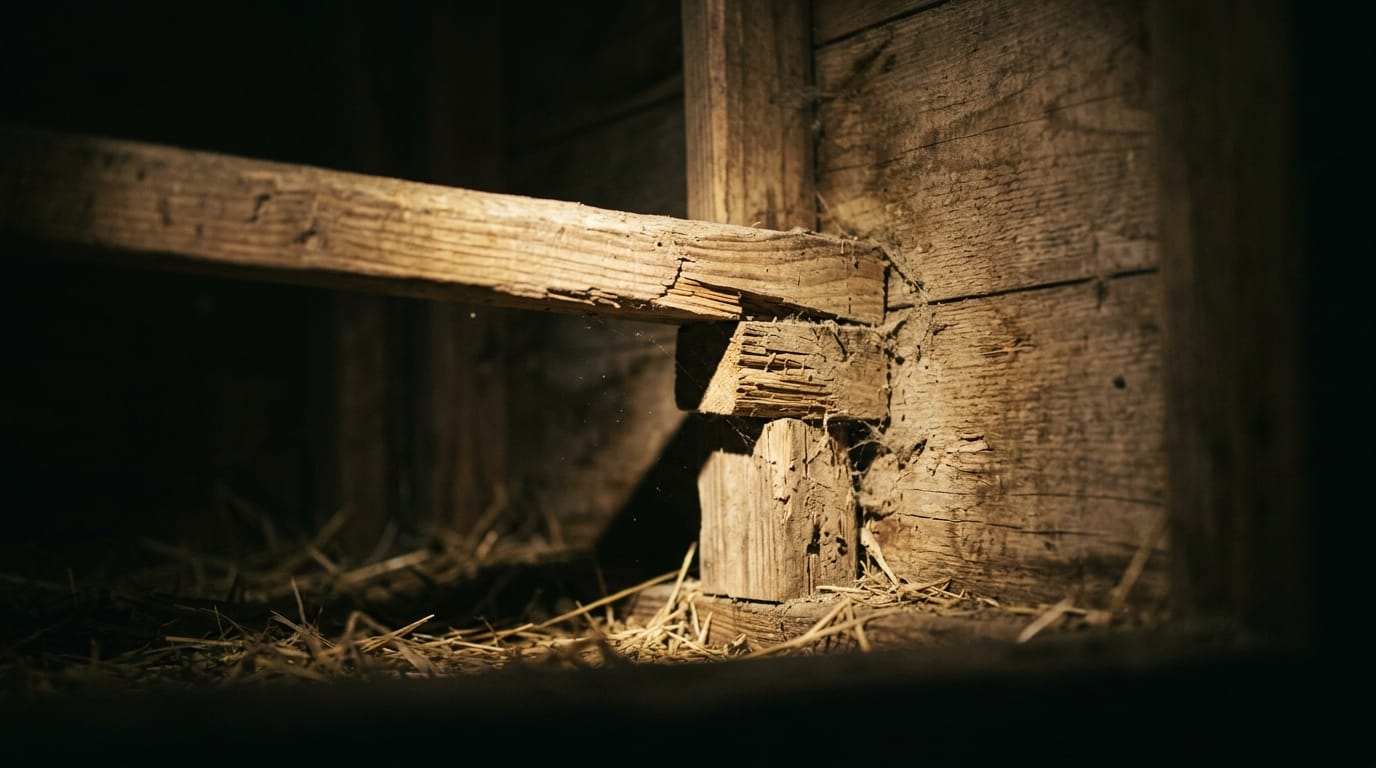
The other mite worth knowing is the red roost mite, and the difference is behavioral. It spends the day hidden in cracks in the coop and comes out to feed at night, so a daytime inspection of the bird finds nothing. Checking the underside of the roost bars and the joints of the coop after dark with a flashlight is the way to find it. Lice run for cover when you part the feathers near the vent and leave pale egg clusters cemented to the feather shafts.
Treatment is a label-reading job rather than a folk-remedy one. Extension guidance points to approved products such as permethrin applied to both the birds and the housing, with repeat applications a couple of weeks apart because nothing available kills the eggs. Check the egg withdrawal instructions on whatever you use before you use it.
Mating Wear, Broody Hens, and Feather Pecking
Mating wear is the one people most often mistake for a molt in spring. A rooster treads the same few hens repeatedly and wears the feathers off their backs and the area behind the head. The patches are clean, they are only on his favorites, and nothing new grows until breeding activity slows. A hen saddle is the usual answer if it gets raw.
A broody hen plucks her own breast feathers deliberately, so her skin can reach the eggs. The bare patch is the breast alone, she is sitting flat in the box all day, and she will complain loudly when you reach under her.
Feather pecking is the one to take seriously, because it feeds on itself. Birds strip each other’s backs and tails, no new feathers appear, and once skin breaks the blood draws more pecking from the rest of the flock. It usually traces back to crowding, boredom or a ration too thin on protein, and it needs the underlying cause fixed rather than the injured bird patched up.
Feeding a Molting Flock
This is where most molt advice goes wrong, and it goes wrong in a well-meaning direction.
Feathers are protein, and the amino acid that matters most is methionine. Mississippi State Extension explains that feathers carry high levels of it, that it is one of the few sulfur-containing amino acids, and that a shortage in the diet shows up directly as reduced growth and poor feather development. Birds short on it will sometimes eat feathers to make up the difference.
So more protein during the molt, and University of Arizona Cooperative Extension recommends exactly that. The catch is the word more. What the bird needs is a higher concentration of protein in what she eats, not a larger pile of food. And the standard extension advice on feather quality is blunt about the difference: do not supplement a complete feed with extra grains such as corn, because doing so dilutes the methionine level of the ration.
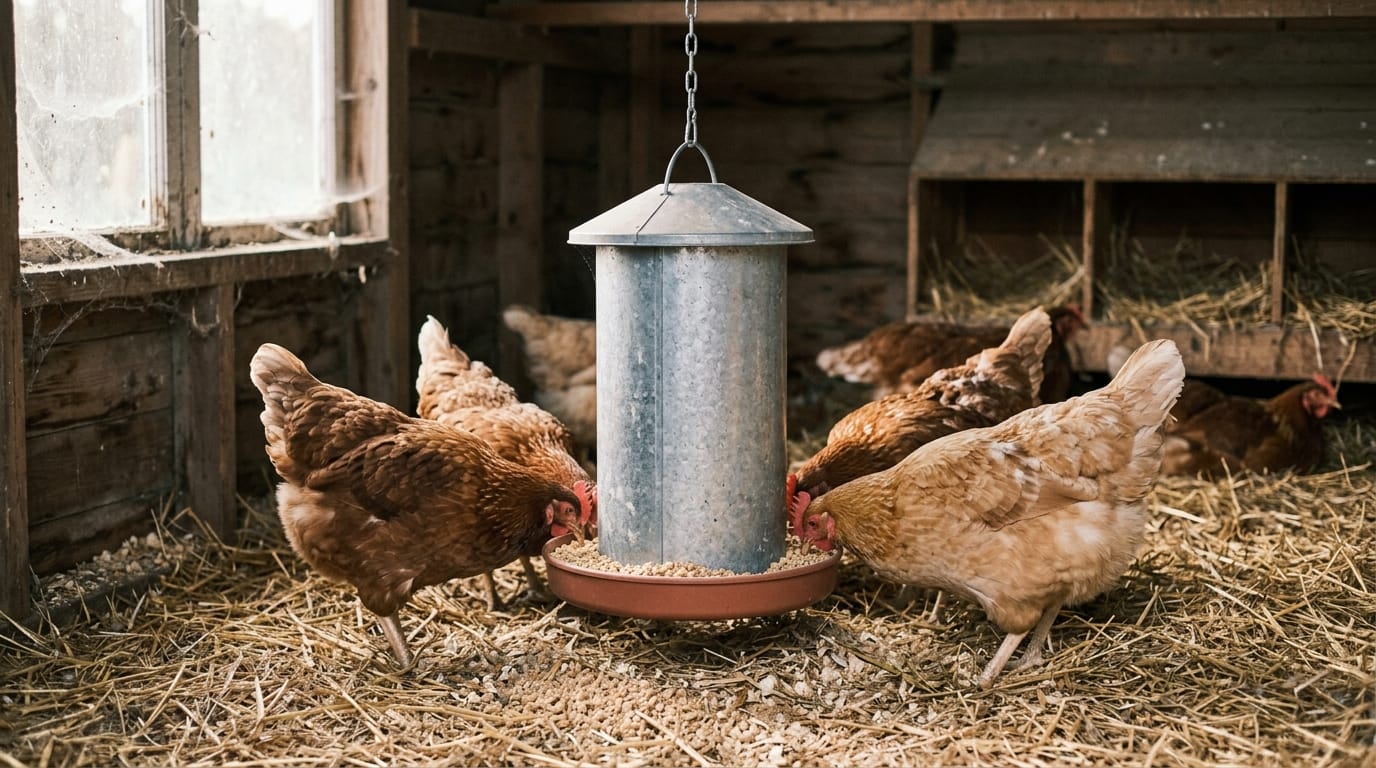
Which means the classic gesture of comfort, tipping out extra scratch for the poor bald hens, actively works against the thing you are trying to help. Scratch is mostly cracked grain. Every scoop of it lowers the average protein of what goes into the bird that day.
What to do instead, in order of how much difference it makes:
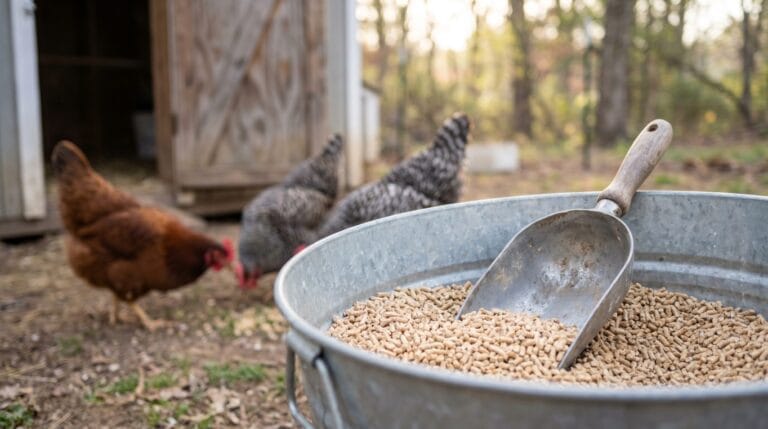
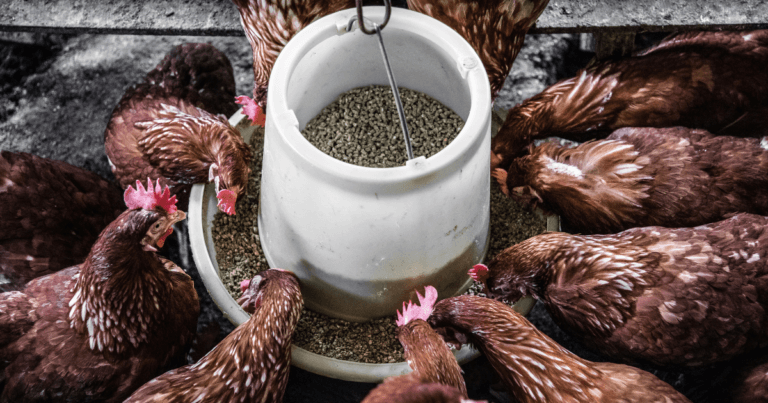
- Move to a more concentrated complete feed while laying has stopped. The molt and grower rations on the shelf generally run eighteen to twenty percent protein against roughly sixteen in a layer feed. Those numbers come off the bag rather than out of a study, but the direction is what matters and the label tells you what you are buying.
- Cut the treats right back while the new coat is coming in. This is the single most useful change and it costs nothing.
- Leave oyster shell out separately so any hen still laying can take what she needs, rather than building the calcium into everyone’s feed.
- Keep water clean and available. Feather growth is unglamorous physiology and it all runs on water.
- Go back to layer feed once the feathers are finished and the eggs restart.
If you mix your own ration rather than buying it, the molt is the point in the year when a thin protein formulation shows up plainly in the birds, and our guide to mixing chicken feed at home covers what has to be in the mix and the shortcuts that cause trouble.
Treats, Scratch, and Supplements
Higher-protein treats such as dried mealworms are a better choice than scratch during a molt, but they are still treats and the dilution logic still applies. A workable rule of thumb is to keep everything that is not complete feed under about a tenth of what the birds eat in a day. Beyond that you are formulating a ration by accident.
Supplements marketed specifically for molting birds are mostly protein and vitamins in a more expensive package than a bag of grower feed. There is nothing wrong with them and nothing magic about them. The feed is doing the work.
New to this and unsure what is normal?
The Backyard Chickens Starter Guide covers a first flock end to end: choosing breeds, sizing a coop and run, feed, the first winter, and what to expect from your own eggs through the year, including the seasons when the basket goes quiet.
Eggs During and After the Molt
Expect the eggs to slow down and in most hens to stop entirely. A bird building a full coat of feathers is not going to lay well at the same time, and the pause is the normal shape of the year rather than a fault to correct. Laying generally picks back up within a few weeks of the last feathers finishing.
The second cycle looks different from the first. There are usually fewer eggs in total, because production steps down a little with each year, but shell thickness and general egg quality tend to improve after a molt. The rest does the bird good. If you want the longer view of how many productive years to expect, we set it out in how long chickens live.
The light question comes up every autumn. Hens need roughly fourteen to sixteen hours of light a day to lay well, and Extension poultry guidance covers supplementing it to hold production through winter. It works. It is also worth knowing that adding light will not shorten a molt that has already started, and that the annual rest has a purpose, so plenty of keepers take the quiet months as they come.
One number is worth remembering from the parasite section: a drop of ten percent or more in laying, with no feathers coming back, is a mite pattern rather than a molt pattern.
How to Handle a Molting Bird
Every one of those pin feathers has a live blood supply inside the sheath until it opens, which is why a molting bird who normally tolerates handling will suddenly object to it. Picking her up hurts, and a snapped pin feather bleeds more than you would expect from something that small.
- Handle molting birds only when you actually need to, and support them rather than gripping the body.
- Skip the health checks that can wait, and keep small children from carrying birds around for a few weeks.
- No baths, no dusting, no fussing with the new feathers.
- If a blood feather does break and bleeds, pressure on the spot usually settles it. Persistent bleeding is a call to a vet.
- Hold off on introducing new birds. A molting hen is uncomfortable and low in the pecking order, and that is a bad moment to renegotiate it.
- Leave the flock the routine it knows. Moves, rehoming and coop rebuilds are better either side of the molt.
Molting Into Cold Weather
Late molters run on into November, which means a bird can be short of her insulation at exactly the point the temperature drops. It looks worrying and it is usually fine, but it is the one situation where a molt deserves some management.
What matters is dry and out of the wind rather than warm. A coop that is well ventilated above the birds and free of drafts at roost level lets moisture out without blowing across them, and dry bedding with enough roost space to sit shoulder to shoulder does more for a thin bird than any appliance. Water that has not frozen matters as much in November as it does in July.
Supplemental heat is a real decision rather than an obvious yes. Heat lamps start coop fires every winter, and birds that come to depend on warmth do badly when the power fails. Most healthy adult birds handle cold weather well if they are dry and sheltered. A bird who is genuinely bare in hard freezing weather is a judgment call, and if you make it, make it with equipment that cannot ignite bedding. Our coop build guide covers ventilation and draft control in the build itself.
When It Is Not a Molt and You Should Call a Vet
A molt needs no treatment. These are the signs that what you are looking at is something else, and they are worth acting on rather than waiting out:
- Bare skin that stays bare for weeks with no pin feathers emerging anywhere.
- A bird who is lethargic, off her feed, or noticeably light when you lift her.
- A pale, shrunken comb together with weight loss, which can point to a parasite load rather than a molt.
- Labored breathing, discharge, or any respiratory noise.
- Scabs, open wounds, or skin that looks infected rather than simply bare.
- Bleeding from a broken feather that does not stop with gentle pressure.
- Heavy feather loss across the entire flock at once, or in spring, with nothing regrowing.
- Feather loss in a bird under about a year old outside the normal juvenile changes.
None of those is a diagnosis. They are the line between watching and getting help, and an avian vet or your state extension poultry specialist is the right next call.
The Free Garden Starter Pack
Five printable pages that take the guesswork out of a first season, plus a short email every week or two when something is worth planting, picking, or putting up.
- A garden planning worksheet you can actually fill in
- A seed-starting and planting calendar
- A harvest log to track what really produced
No spam, ever. Unsubscribe in one click.
Thank you. You are on the list.
Your Garden Starter Pack is ready right now. Grab it here:
Download the pack (PDF)Keep an eye on your inbox. The next seasonal guide lands there first.
Common Questions About Molting Chickens
Do chickens molt every year? Yes, once a year as adults, normally in fall. The first one comes at around sixteen to nineteen months of age, so a spring-hatched bird skips her first autumn.
How long do chickens molt for? Two to three months if she drops feathers fast, four to six if she does it slowly. Counting regrown wing primaries gives you a rough position in that range.
Do chickens molt in the spring? The annual molt is a fall event driven by shortening days. Feather loss in spring is more often mating wear, parasites, or a broody hen, so work through the bare-patch table before assuming a molt.
Will my chickens lay during a molt? Most stop. A few carry on at a reduced rate. Laying returns within a few weeks of the coat finishing, usually with better shells than before.
Do roosters molt? They do, on the same seasonal schedule. Roosters also tend to carry heavier mite populations than hens, so they are a sensible bird to inspect first when you are trying to tell the two apart.
Should I give molting chickens extra treats? No. Extra scratch and grain dilute the protein and the methionine in the ration, which is the opposite of what feather growth needs. Concentrate the feed and cut the treats.
Do I need to separate a molting hen? Not normally. Separate her only if the others are pecking her bare skin to the point of drawing blood, and then fix the crowding or boredom that started it.
My chicken is bald on her back. Is that a molt? Usually not. A bare back with clean edges and no pin feathers, on a hen in a flock with a rooster, is mating wear. A molt starts at the head and neck and brings new quills through within days.