Best Electric Smokers for Beginners: 6 Picks (2026)
In Homestead is reader-supported. When you buy through links on this page, we may earn a small commission at no extra cost to you. See our affiliate disclosure. As an Amazon Associate I earn from qualifying purchases.
There is a moment on a cool fall afternoon when a thin ribbon of blue smoke drifts off the smoker and the whole yard smells of hickory. For a homesteader, smoking meat is one of the most satisfying ways to turn a harvest, whether that is your own chickens, a deer or a cooler of fish, into something special.
An electric smoker is the easiest way to start. You plug it in, set the temperature and add wood chips, and the element does the fire-tending for you. But electric smokers vary in size, controls, how they feed wood and how well they handle cold weather, and some popular models have had safety recalls.
This guide compares six electric smokers for beginners, explains how electric compares with pellet smokers, and covers the food safety rules that matter more than any feature, using USDA and extension guidance.
Table of Contents
Quick Picks
- Best overall for beginners: the Masterbuilt 30-Inch Digital. Simple digital controls, a side chip loader and four racks.
- Best for bigger batches: the Masterbuilt 40-Inch Digital. The same controls with about 970 square inches of space.
- Best with app control: the Masterbuilt 710 WiFi. Watch the smoker and meat probe from your phone.
- Best budget pick: the Masterbuilt 30-Inch Analog. A simple dial and nothing electronic to fail.
- Best automatic smoke feed: the Bradley Digital 4-Rack. Up to nine hours of smoke without refilling.
- Best small smoker for fish and jerky: the Smokehouse Little Chief. Light, simple and steady at low heat.
Why an Electric Smoker Suits Beginners
Most electric smokers are insulated cabinets with a heating element at the bottom. The element provides the heat, and depending on the model, smoke comes from wood chips, bisquettes or chunks smoldering above it. Many cabinets also have a water bowl that catches drippings and adds moisture. On models with a thermostat, it regulates the cabinet at the temperature you set; a few simple smokers, like the Little Chief, run at a fixed temperature instead.
That means no lighting charcoal, no adjusting vents and no propane tank to watch. You still choose the wood, check the meat and top up the chips, but holding a steady temperature, the hardest skill in smoking, is mostly handled for you.
Electric Smoker vs Pellet Smoker
Both plug into an outlet and hold a set temperature with little fire tending. The difference is the fuel. A pellet smoker burns wood pellets that an auger feeds automatically, while an electric smoker heats with an element and only smolders a small charge of chips for flavor.
| Electric smoker | Pellet smoker | |
|---|---|---|
| Heat source | Electric element | Burning wood pellets |
| Smoke | Wood chips or bisquettes, refilled as needed | Pellets fed automatically |
| Bark and crispy skin | Harder, because the cabinet is moist and airflow is low | Usually easier |
| Upkeep | Water bowl, drip tray, chip tray | Hopper, auger and ash cleanout |
| Cost | Often lower | Often higher |
| Best for | Simple low-and-slow cooks, fish, jerky, cheese | Bark-heavy barbecue and grilling too |
For a beginner who mainly wants smoked chicken, pork, fish and jerky without a learning curve, electric is the simpler start. If a dark, crusty brisket bark matters most to you, a pellet smoker is worth a look.
What to Look for in an Electric Smoker
Capacity You Will Actually Use
Makers list total rack area in square inches. Around 500 to 700 square inches suits most families; a 40-inch cabinet makes sense if you smoke whole birds in batches or put up a lot of jerky. Bigger cabinets take longer to heat and more space to store.
Digital, WiFi or Analog Controls
Digital controllers let you set an exact temperature and a timer. WiFi or Bluetooth models add phone monitoring, and some include a meat probe. Analog dials are cheaper and simpler but less precise, so pair one with a separate thermometer. Whatever the controls, the thermostat measures the cabinet, not the food.
How the Wood Gets In
Most electric smokers burn wood chips in a tray. A side loader, like Masterbuilt’s, lets you add chips without opening the door. Bradley smokers feed their own wood bisquettes automatically, which is convenient but ties you to one brand of fuel. Masterbuilt also sells a Slow Smoker attachment that feeds chips automatically for up to six hours on compatible models; check its fit guide against your model number.
Insulation and Cold Weather
Wind, cold and a cold load of meat all lengthen a cook. Better insulation helps a smoker hold its temperature outdoors in fall and winter, and Smokehouse notes that cold conditions slow its smokers down. If you smoke year-round in a cold climate, insulation matters more than extra features.
Power, Cords and Placement
An electric smoker needs a grounded outdoor outlet with ground-fault (GFCI) protection. If you need an extension cord, follow your model’s manual. Masterbuilt’s manual, for example, calls for a grounded, three-wire outdoor cord rated at least as high as the smoker, with the connection kept dry and off the ground. Masterbuilt also says to keep its smokers at least 10 feet from any structure and never to use them in a garage or covered area.
Check recalls before you buy, too. In 2024 Char-Broil recalled about 211,700 digital electric smokers that could leak electrical current, according to the U.S. Consumer Product Safety Commission. If you buy any used smoker, look up the model number first.
The 6 Best Electric Smokers for Beginners
Best Overall for Beginners
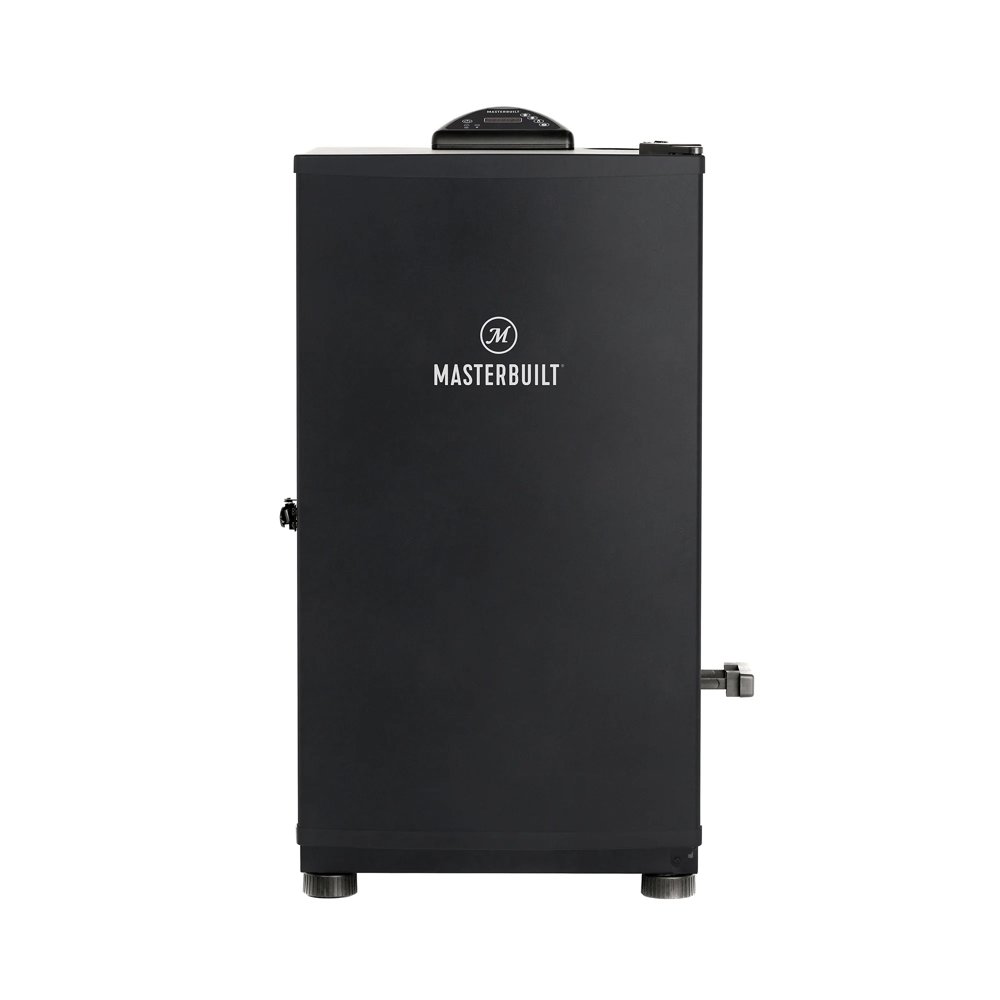
Masterbuilt 30-Inch Digital Electric Smoker (MB20071117)
This is the electric smoker most beginners should look at first. Set the time and temperature on the digital panel, anywhere from 100 to 275 F, and the element holds the cabinet there. Masterbuilt’s patented side loader lets you add wood chips without opening the door and letting the heat out.
Four racks give about 710 square inches of space, which Masterbuilt says fits up to four pork butts or four racks of ribs. That is plenty for a family, a holiday turkey or a batch of smoked chicken from your own birds. It comes with a removable water bowl and a one-year warranty.
- Best for: first-time smokers who want simple digital controls and room for real batches.
- Keep in mind: owners report occasional controller and element failures, and the chips need topping up every so often during a long smoke. Check meat with your own thermometer rather than trusting the panel.
Best for Bigger Batches
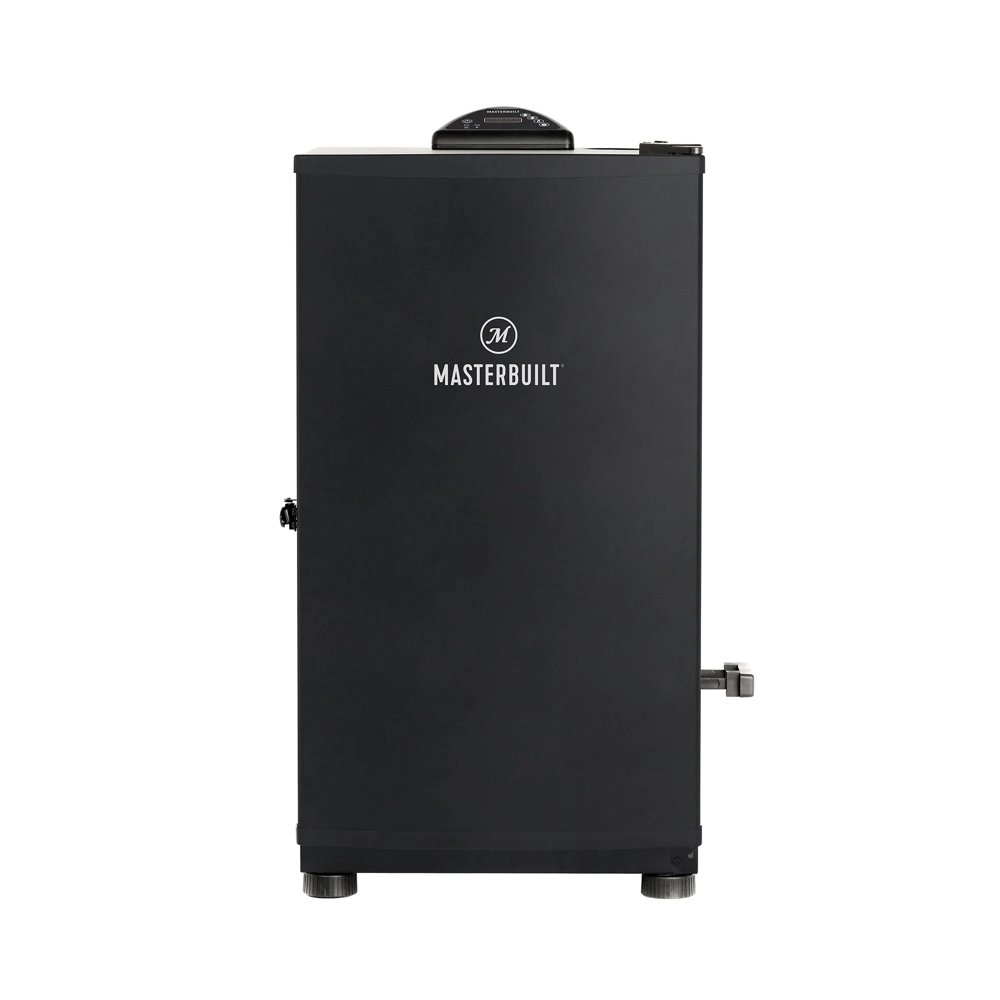
Masterbuilt 40-Inch Digital Electric Smoker (MB20072918)
The 40-inch version uses the same simple digital controls, 100 to 275 F range and side chip loader as the 30-inch, in a taller cabinet with about 970 square inches across four racks.
Masterbuilt rates it for up to eight pork butts or eight racks of ribs, which makes sense if you process your own meat chickens, smoke for a crowd or put up several pounds of jerky at once.
- Best for: larger households and anyone smoking for gatherings or big harvests.
- Keep in mind: it is heavier and takes up more patio space, and how often you refill the chip loader varies with the cook. This Masterbuilt model carries a one-year warranty.
Best with App Control
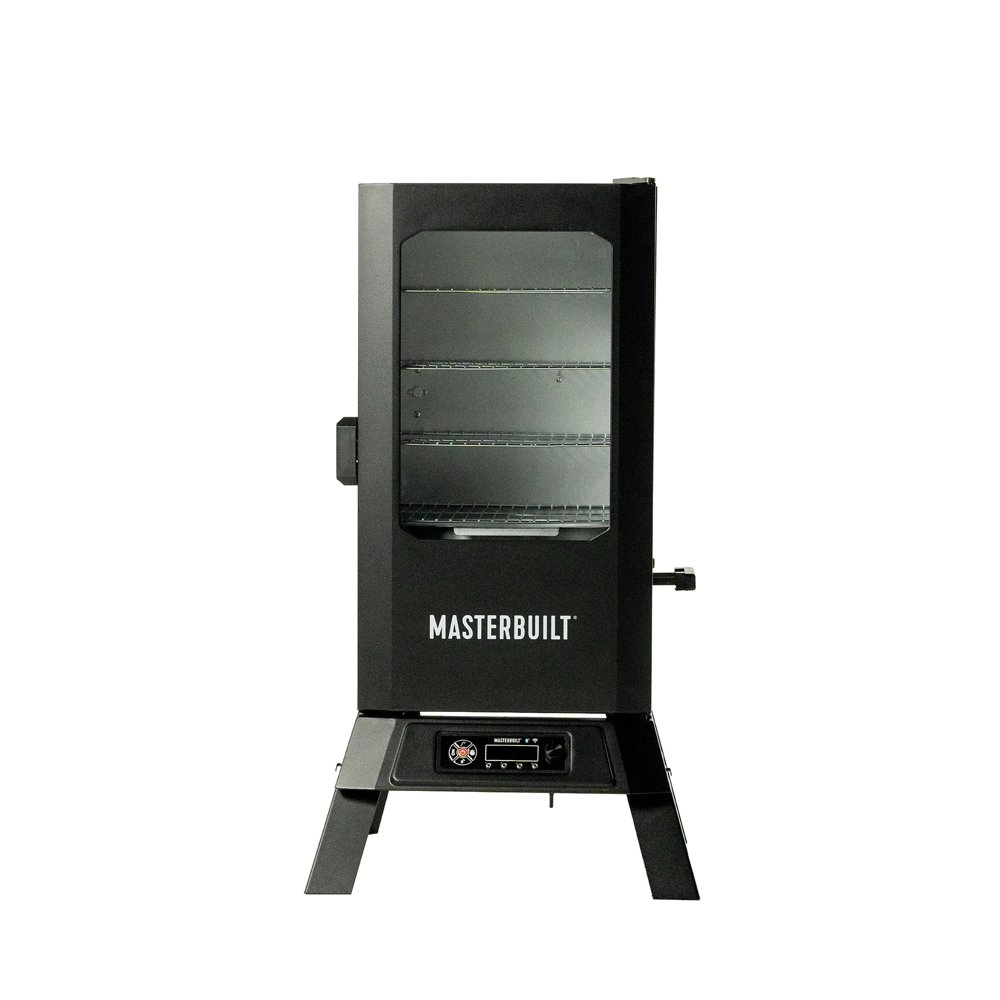
Masterbuilt 710 WiFi Digital Electric Smoker (MB20070924)
If you like checking on a long smoke from the kitchen, the 710 WiFi pairs the 30-inch-class cabinet, about 710 square inches on four racks, with Masterbuilt’s app. You can set and watch the smoker temperature and the included meat probe from your phone.
The range is the same 100 to 275 F, and the side loader still handles the wood chips.
- Best for: beginners who want to monitor a long cook without standing at the smoker.
- Keep in mind: owners mention pairing interruptions and occasional probe or controller errors. The app cannot add wood chips for you, so you still need to check in.
Best Budget Pick
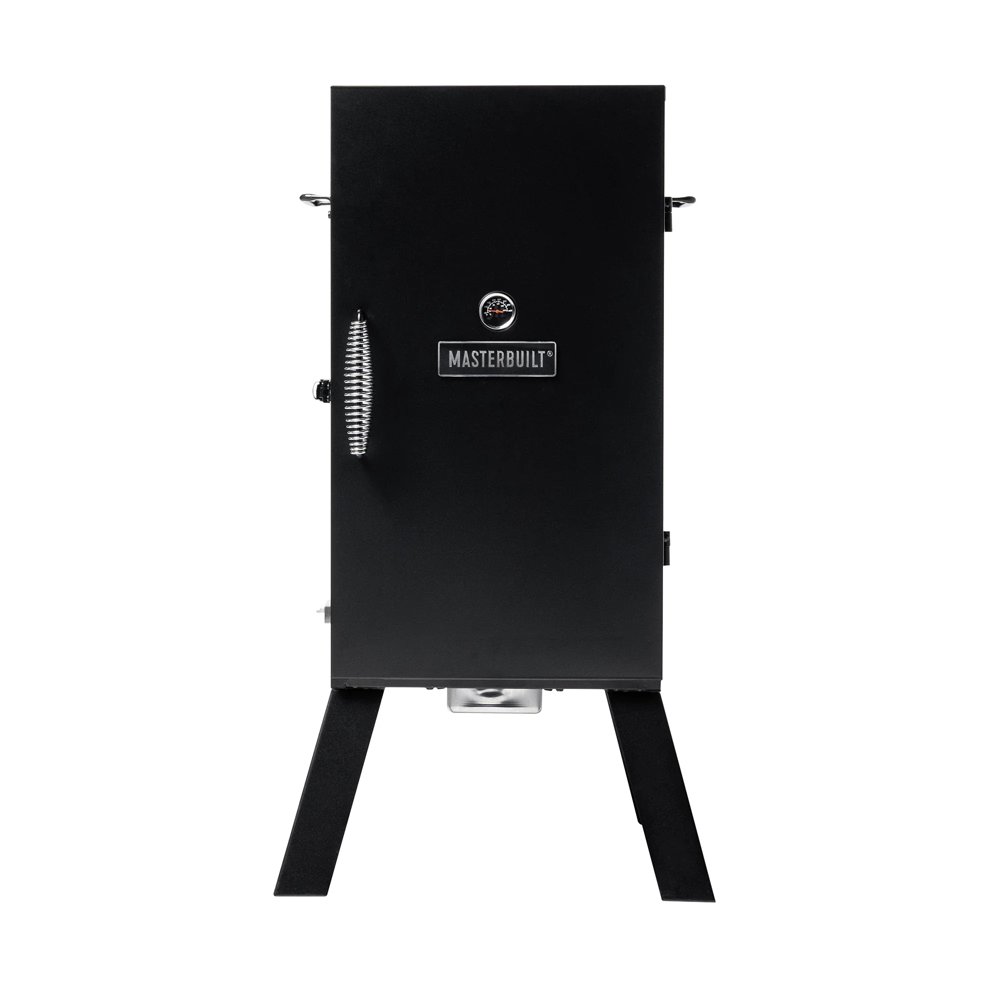
Masterbuilt 30-Inch Analog Electric Smoker with Legs (MB20070210)
The analog Masterbuilt is the simplest way in. A dial sets the heat, up to 275 F, and a removable tray holds the wood chips. It has three racks with about 530 square inches of space, enough for three chickens or two turkeys.
There is no screen or timer to fail, and it stands on legs so you are not bending as far to load it.
- Best for: beginners on a budget who are happy to watch the temperature themselves.
- Keep in mind: analog dials are less precise than digital controllers, owners report units that struggle to reach temperature, and adding chips means opening the door. Use a separate smoker thermometer.
Best Automatic Smoke Feed
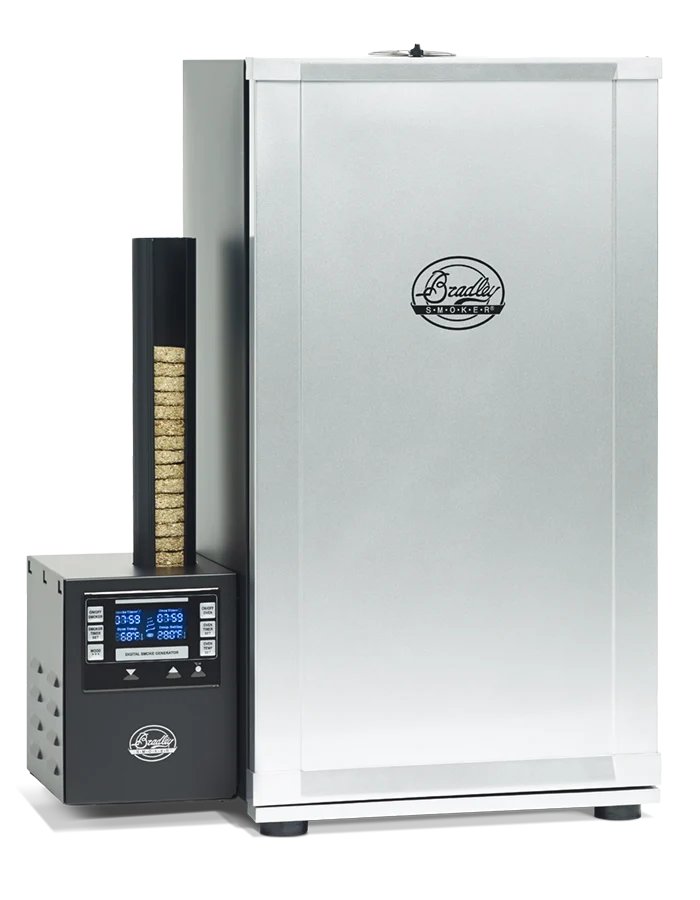
Bradley Digital 4-Rack Smoker (BTDS76P)
The Bradley takes a different approach to wood. Instead of loose chips, it feeds compressed wood bisquettes one at a time onto a small burner, so it produces steady smoke for up to nine hours without refilling, according to Bradley. Smoke, heat and time each have their own digital control.
It has four racks with 572 square inches in total, a maximum of 280 F, and works with Bradley’s cold smoke adapter, sold separately, which is useful for cheese.
- Best for: beginners who want automatic wood feeding for long cooks, cheese and fish (you still check the food).
- Keep in mind: you can only use Bradley’s bisquettes, which are an ongoing cost, and owners report it can struggle to reach temperature outdoors in winter.
Best Small Smoker for Fish and Jerky
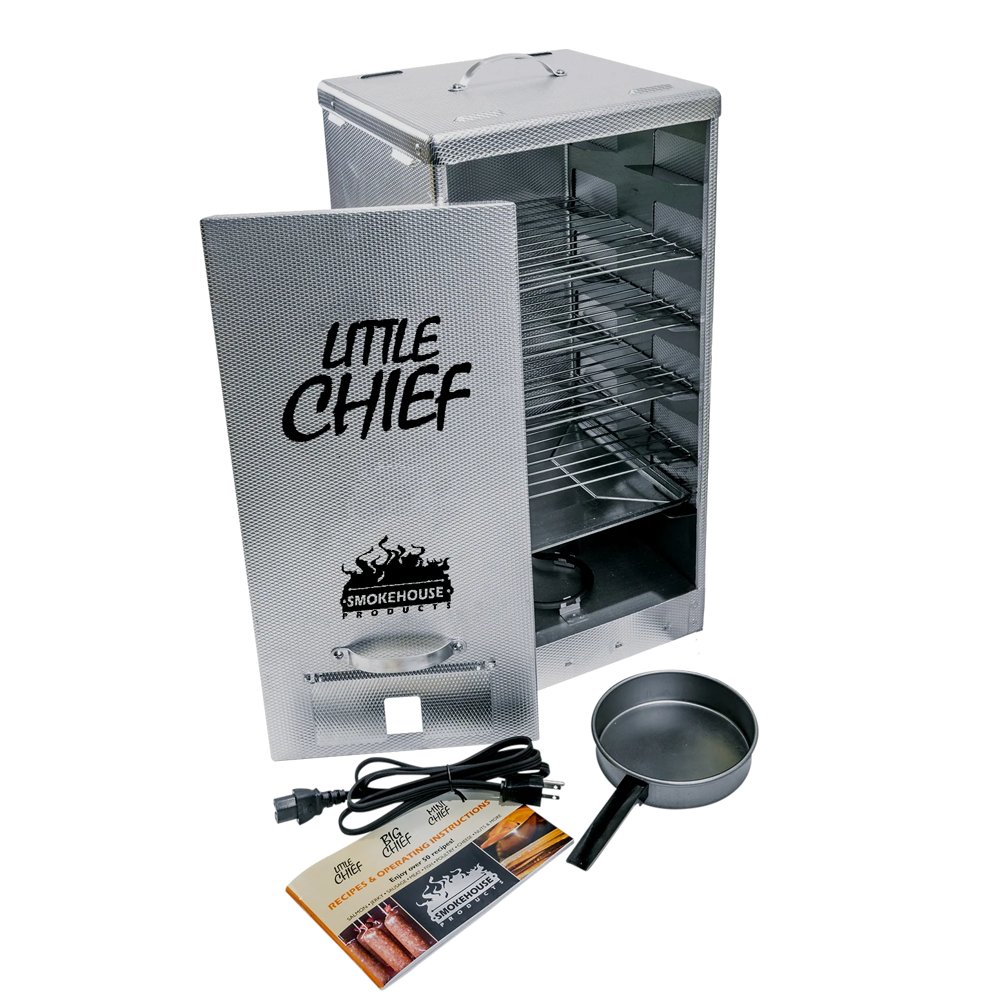
Smokehouse Little Chief Front Load Smoker
The Little Chief is a small, lightweight aluminum box smoker that has long been popular for fish and jerky. It has four racks and a pan for wood chips and runs at a fixed temperature of about 165 F, with no dial to set.
That low, steady heat is what makes it good at smoking salmon, trout and jerky slowly. At about 12 pounds, it is easy to store and carry.
- Best for: smoking fish and jerky in small batches.
- Keep in mind: there is no temperature control, and cold or wind slows it down. Its fixed heat does not guarantee food reaches a safe temperature, so follow the food safety steps below and finish in the oven when needed.
Quick Comparison
| Pick | Capacity | Temperature | Controls | Wood |
|---|---|---|---|---|
| Masterbuilt 30″ Digital | About 710 sq in, 4 racks | 100 to 275 F | Digital | Wood chips, side loader |
| Masterbuilt 40″ Digital | About 970 sq in, 4 racks | 100 to 275 F | Digital | Wood chips, side loader |
| Masterbuilt 710 WiFi | About 710 sq in, 4 racks | 100 to 275 F | Digital + app, probe | Wood chips, side loader |
| Masterbuilt 30″ Analog | About 530 sq in, 3 racks | Up to 275 F | Analog dial | Wood chips, tray |
| Bradley Digital 4-Rack | 572 sq in, 4 racks | Up to 280 F | Digital | Bradley bisquettes, automatic |
| Smokehouse Little Chief | 4 racks | Fixed, about 165 F | None | Wood chips, pan |
Smoking Food Safely
Cook to Food Temperature, Not Smoker Temperature
The temperature on the smoker is the air in the cabinet. What keeps you safe is the temperature inside the food, so check it with a reliable thermometer. For many hot-smoked meats, about 225 to 250 F is a common starting point, and USDA’s guidance for smoking turkey calls for keeping the smoker between 225 and 300 F.
Then cook to USDA’s safe minimum internal temperatures:
| Food | Safe minimum internal temperature |
|---|---|
| All poultry, including ground | 165 F |
| Ground beef, pork, lamb and veal | 160 F |
| Whole cuts of beef, pork, lamb and veal | 145 F, then rest 3 minutes |
| Fish | 145 F |
Jerky Needs a Heat Step
Drying alone does not make jerky safe. USDA explains that evaporating moisture can keep the meat below a safe temperature while it dries, so it recommends heating meat to 160 F, and poultry to 165 F, before drying. The National Center for Home Food Preservation also gives an oven method for heating dried meat strips afterward. Follow one of these tested methods rather than relying on the smoker’s setting.
Hot Smoking vs Cold Smoking
Hot smoking cooks the food while it smokes, and it is what every smoker on this list is built for. Cold smoking, below about 80 to 90 F, adds flavor without cooking. Pacific Northwest Extension describes cold-smoked fish as unpasteurized, and cold-smoked meat and fish need carefully controlled curing and temperatures, so they are not a beginner project.
Hot-smoked fish has its own extension process, beyond the ordinary 145 F cooking minimum: the same guide calls for proper brining and holding the fish at 150 F or above, preferably 160 F, for 30 minutes, then refrigerating it at 38 F or below. Cheese is the easy exception; cold smoking cheese below 90 F is a common first cold-smoke project, but keep it refrigerated afterward.
Smoking Is Not Preserving by Itself
Smoking alone does not make meat, fish or cheese shelf-stable. Refrigerate or freeze them unless you follow a separate, tested preservation process, such as properly drying jerky. Penn State Extension and Oregon State Extension both treat smoked fish as a perishable food. Our guide to methods of preserving food at home explains where curing and smoking fit, and a vacuum sealer helps smoked meat and fish keep well in the freezer, though vacuum sealing does not make them shelf-stable either.
Finally, keep safety simple: use the smoker outdoors only, at least the distance your manual gives from buildings, never in rain, and clean grease from the drip tray after each cook. If a grease or electrical fire starts, switch off the power if it is safe to do so, keep clear and never throw water on it.
How We Chose
These smokers were researched rather than tested side by side, and we would rather say that plainly. We compared the makers’ published capacity, temperature range, controls and warranty, how each feeds wood, insulation for cold-weather use and safety guidance in their manuals. We also read owner reviews for recurring issues, such as controller failures or slow winter heating, without treating them as failure rates, and we checked recall records.
We do not list prices, because they change constantly. Use the buttons to check current prices.
Frequently Asked Questions About Electric Smokers
Are electric smokers good for beginners?
Yes. They are the easiest smokers to run because the element and thermostat hold the temperature for you. You still need a meat thermometer and the occasional chip refill.
Is an electric or pellet smoker better?
Neither is better for everyone. Electric smokers are simpler and often cheaper, and they do well with fish, jerky, poultry and cheese. Pellet smokers burn real wood for heat, which usually makes better bark, and many can also grill, but they need more upkeep.
Can you use an electric smoker in a garage or on a covered porch?
No. Masterbuilt says never to use its electric smokers in a garage or covered area and to keep them at least 10 feet from structures. Smoldering wood still produces smoke and carbon monoxide, so always use a smoker outdoors in the open.
Can you make jerky in an electric smoker?
Yes, as long as the meat gets a proper heat step. USDA recommends heating meat to 160 F, and poultry to 165 F, before drying, because a smoker set to a low temperature does not guarantee the meat itself gets that hot.
Can you cold smoke cheese in an electric smoker?
Yes, with an attachment that makes smoke without heating the cabinet, such as Bradley’s cold smoke adapter. Keep the cabinet below about 90 F so the cheese does not melt, and refrigerate it afterward.
The Bottom Line
For most beginners, the Masterbuilt 30-Inch Digital Electric Smoker is the one to start with: simple digital controls, a side chip loader and room for real batches. Go bigger with the Masterbuilt 40-Inch if you smoke for a crowd, or pick the Smokehouse Little Chief if fish and jerky are your main goal. Whatever you choose, cook to the food’s internal temperature, refrigerate what you smoke, and keep the smoker outdoors.